
Call for participation in the post-graduate course and research conference
13th Graduate Spring School & Research conference on Comparative Media Systems: “Automated Publicity: The Impact of AI on Media and Journalism”
co-organized with the ECREA CEE Network
IUC, Dubrovnik, 7-11 April 2025
What is the impact of AI on public sphere and journalism? Chat GPT summarized the answer as follows:
AI and automation is used not only in content creation in journalism, but across government and corporate services, in governing of news feeds on social media, to produce deepfakes and misinformation. AI powered data analytics could aid in investigative journalism, but its discruption of the existing business models for the media could further agravate the position of news media. The struggle around economic and symbolic power was highlighted by the recent strikes of the film industry and lawsuits for copyright infringement by the New York Times against OpenAI and Microsoft.
Automation is used not only in content creation in journalism, but across government and corporate services, in governing of news feeds on social media, in deepfakes and misinformation strategically implemented both by local and international actors. AI powered data mining could aid in investigative journalism, but its disruption of the existing business models for the media could further agravate the position of news media. The first threat to the film industries was already faced, but will certainly not be the last one. AI also challenges journalism education in manifold ways, depending on the constraints of local media systems and journalism cultures.
The course & research conference will discuss new research in the area of AI, automation and the public sphere. The course will also include a hands-on methodological workshop focusing on comparative methods.
Lecturers include:
Göran Bolin, Södertörn University, Stockholm
Carmen Ciller, Universidad Carlos III de Madrid, Spain
Susanne Fengler, TU Dortmund, Germany
Anne Kaun, Södertörn University, Stockholm
Paolo Mancini, Università di Perugia, Italy
Zrinjka Peruško, University of Zagreb, Croatia
Fredrik Stiernstedt, Södertörn University, Stockholm
Miklós Sükösd, University of Copenhagen, Denmark
Merle van Berkum, TU Dortmund, Germany
This 13th “slow science” IUC-CMS is an interdisciplinary research conference & post-graduate course open to academics, doctoral and post-doctoral students in media, communication and related fields engaged with the issue of media and media systems, that wish to discuss their current work with established and emerging scholars and get relevant feedback.
Invited research conference participants will deliver keynote lectures with ample discussion opportunities. In this unique academic format, student course attendees will have extended opportunity to present and discuss their current own work with the course directors and other lecturers and participants in seminar form (English language) and in further informal meetings around the beautiful old-town of Dubrovnik (UNESCO World Heritage) over 5 full working days (Monday to Saturday).
The working language is English.
Participation in the course for graduate (master and doctoral) students brings 3,5 ECTS credits, and for doctoral students who present their thesis research 6 ECTS. The course is accredited and the ECTS are awarded by the Faculty of Political Science, University of Zagreb (www.fpzg.unizg.hr). All participants will also receive a certificate of attendance from the IUC.
Enrolment
To apply, send a CV and a motivation letter to zrinjka.perusko@gmail.com Students who wish to present their research should also send a 300 word abstract. The course can accept 20 students, and the applications are received on a rolling basis. After notification of acceptance you need to register also on this web page https://iuc.hr/programme/1844.
The IUC requires a small enrolment fee from student participants. Participants are responsible for organizing their own lodging and travel. Affordable housing is available for IUC participants. Stipends are available from IUC for eligible participants, further information at https://www.iuc.hr/iuc-support.php. For information on these matters please contact the IUC secretariat at iuc@iuc.hr.
Venue Information
The Inter-University Centre was founded in Dubrovnik in 1972 as an independent, autonomous academic institution with the aim of promoting international co-operation between academic institutions throughout the world. Courses are held in all scientific disciplines around the year, with participation of member and affiliated universities.
Additional Information
For further information about academic matters please contact the organizing course director: professor Zrinjka Peruško zrinjka.perusko@gmail.com, Centre for Media and Communication Research (www.cim.fpzg.unizg.hr), Department of Media and Communication, Faculty of Political Science (www.fpzg.unizg.hr), University of Zagreb (www.unizg.hr).
12th Graduate Spring School & Research conference on Comparative Media Systems
Co-organized with the ECREA CEE Network
Media and Trust
IUC, Dubrovnik, 8-12 April 2024
Venue: https://iuc.hr
Don Frana Bulića 4, 20000 Dubrovnik, Croatia
The cultures of trust are different across Europe, linked not only to the present day but also to different histories that shape the present. The broader issue of decreasing trust in institutions and how this impacts democratic governance is also coupled with interpersonal trust in the media. Similarly, trust in media organisations is shaped by different contextual factors in the media system and in different cultural settings, as well as by different practices among media audiences and users. Furthermore, citizens often rely on “trusted systems”, for shopping, banking, health, and everyday sociality. How does this technological trust relate to trust in organisations (governmental, corporate or civil society)?
In the era of automated systems, fake news and deep fakes, how do we understand trust in public communication? How is trust related to truth or fact? In which situations are the editorial, legacy media, the ones that citizens put their trust in? Or, do citizens in certain situations rely more on social media, because the legacy media have been undermined and distrusted alongside with governments, parliaments, and political parties? The situation varies when viewed in the international comparative perspective. What does trust mean for the citizens? How is trust studied methodologically across Europe?
Agenda
Monday, 8 April 2024
9:30-10:00 Zrinjka Peruško, University of Zagreb
Introduction to the course and the topic
10:00-11:00 Göran Bolin, Södertörn University
“Trust and Surveillance: Cross-Cultural Variations of Social and Institutional Trust”
11:00-11:30 Coffee break
11:30-12:30 Paolo Mancini, University of Perugia
“Trust/confidence and political polarization”
12:30-13:30 Stina Bengtsson, Södertörn University
“Two Logics of Media Trust: Epistemic Evidence and Digital News and Information”
Lunch break
Tuesday, 9 April 2024
10:00-11:00 Anne Kaun, Södertörn University
“Reconfiguring Trust in Digital Welfare Regimes: Comparing Citizen – State Relations Across Eight European Countries”
11:00-11:30 Coffee break
11:30-12:30 Zlatan Krajina, University of Zagreb
“Trust as a source of tactical alliance: communicative practices of conviviality among people from former Yugoslav countries and Italians in Trieste”
12:30-15:30 Lunch break
Doctoral students’ presentations:
15:30- 16:00 Virgo Siil, University of Tartu
Creating Trust with Slowness
16:00-16:30 Yan Miao, Jagiellonian University
“Museum as a Medium of Political Communication on the Example of Museums in China”
16:30-17:00 Utku Bozdag, Corvinus University of Budapest
“Populism and Political Communication in Turkish Social Media: A Comparative Analysis”
17:00-17:30 Else Mikkelsen Båge, Karlstad University
“From Monopoly to Modernity: A Comprehensive Exploration of Public Service Broadcasting, Paternalism, and Media Dynamics in Sweden”
17:30-18:00 Monika Szafrańska, Jagiellonian University
“Fact-Checking as a New Phenomenon on the Media Market. Classification of the Trend Within the Polish Media Landscape”
Wednesday, 10 April 2024
9:30-13:30 Dina Vozab & Filip Trbojević, University of Zagreb
Methodological Workshop: fuzzy set qualitative comparative analysis (fsQCA)
Lunch break & organized city sightseeing
Thursday, 11 April 2024
9:00-10:00 Fredrik Stiernstedt, Södertörn University
“Trust and the Media: Arguments for the (Irr)elevance of a Concept”
10:00-11:00 Susanne Fengler, Technische Universität Dortmund
„Trust and media across journalism cultures and media systems: Results from the Global Handbook of Media Accountability“
11:00-11:30 coffee break
11:30-12:30 Miklós Sükösd, University of Copenhagen
“AI-Generated Texts and Media Theory”
12:30-16:00 Lunch break
Doctoral students’ presentations:
16:00-16:30 Wiktoria Aleksandra Barańska, Jagiellonian University
“To Meet Someone, to Get to Know Someone or to Watch Someone? The Changing Functions of LGBT+ Press in Poland”
16:30-17:00 Mariia Aleksevych, Paris Londron University, Salzburg
“News media ownership and trust: Exploring relations across media systems in the European Union”
17:00-17:30 Elena Broda, University of Gothenburg
“Misperceptions and the Media: A Multi-Issue Cross-Media Perspective”
17:30-18:00 Jullietta Stoencheva, Malmö University
“Everyday Extremism in Sweden and Bulgaria: Tracking, Attuning, and Limiting the Spread of Extremist Narratives”
Friday, 12 April 2024
9:00-10:00 Antonija Čuvalo, University of Zagreb
“Revisiting trust in media for digital era”
10:00-11:00 Dina Vozab, University of Zagreb
“Media Dependency in a Multiple Crisis: Information Seeking and Media Trust After an Earthquake During the Covid-19 Pandemic”
11:00-11:30 Coffee break
11:30-12:30 Aleksandra Dragojlov, Jagiellonian University
“Citizens Trust in the Newly Adopted Serbian Media Strategy (2020-2025)”
Closing ceremony, course evaluation, awarding of the certificates
Emisija Kozmos i etos Hrvatski radio, emitirana 23.03. u 08:45
Uloga medijskog sustava za deliberativnu demokraciju.
Emisija aktualizira teme iz područja znanosti, filozofije i umjetnosti. Tražimo odgovore na pitanja koja se dohvaćaju čovjekova položaja u našemu postindustrijskom odnosno postmodernom društvu u Hrvatskoj i svijetu. Autor i voditelj emisije je Marito Mihovil Letica.
Emisija je razgovor sa Zrinjkom Peruško i Dinom Vozab o Obzor 2020 projektu MEDIADELCOM u kojem sudjeluju u hrvatskom timu Centra za istraživanje medija i komunikacije Fakulteta političkih znanosti Sveučilišta u Zagrebu, koji komparativno u 14 europskih zemalja istražuje kakav je odnos tipova medijskih sustava i ostvarenosti deliberativne demokracije.
PoDcast Kolektiv ep. 13: Medijska pismenost i civilno društvo (Zrinjka Peruško)
“Povodom 6. Dana medijske pismenosti koji se obilježavaju krajem travnja 2023. godine u organizaciji Agencije za elektroničke medije i ured UNICEF-a za Hrvatsku, važno je razgovarati o temi medijske pismenosti i civilnog društva i demokracije i medija u današnjici. Mediji utječu na načine ponašanja, na identifikaciju i socijalizaciju pojedinaca i društva. Stoga je uz razvoj kvalitetnog medijskog sustava i razvoj kvalitetnih medijskih javnih politika, kojima bi se osiguralo kvalitetno informiranje i za koje su u prvom redu odgovorni država i stručnjaci, sve važnije i medijsko obrazovanje kojim bi se primatelj poruke, čitatelj ili gledatelj, medijski opismenio i osposobio za kritičku analizu informacije. Kakvu ulogu tu može imati civilno društvo, kako može doprinijeti osnaživanju medijske pismenosti kod građana, kako možemo doskočiti borbi protiv lažnih vijesti, samo su neke od tema o kojima ćemo razgovarati sa prof.dr.sc. Zrinjkom Peruško, redovitom profesoricom medijske i komunikacijske teorije i medijskih sustava i predstojnicom Centra za istraživanje medija i komunikacije Fakulteta političkih znanosti u Zagrebu, koja se u svojim istraživanjima bavi pitanjima medija u demokraciji, medijskih sustava, medijske politike, te je o tim temama objavila veći broj znanstvenih radova u knjigama i časopisima, u zemlji i inozemstvu.” (PoDcast Kolektiv)
Održan MEDIADELCOM okrugli stol „Rizici i mogućnosti za medijske krajolike: znanost za razvoj novinarstva i medijskih politika“
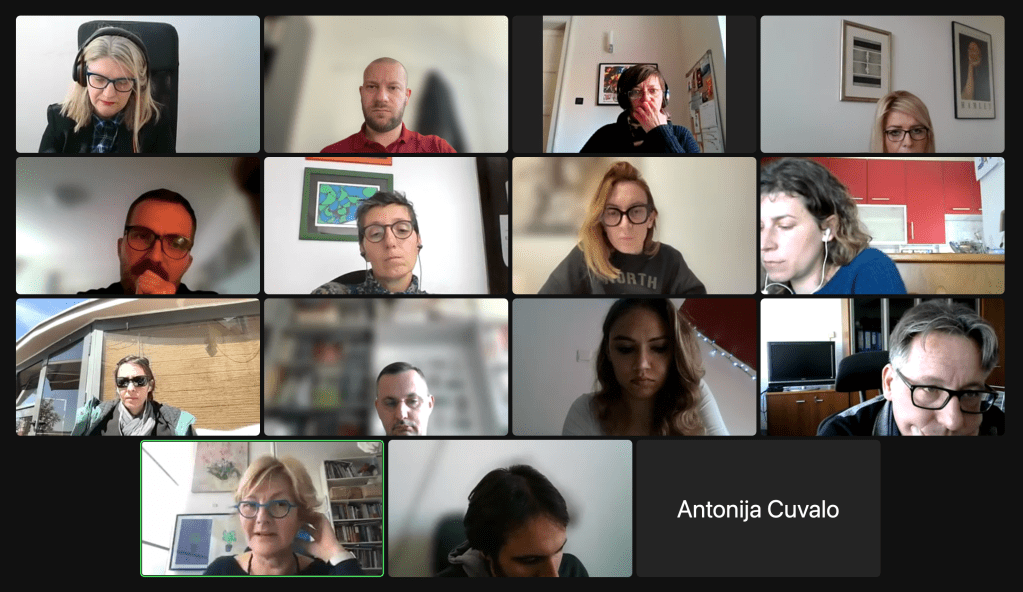
Centar za istraživanje medija i komunikacije (CIM) organizirao je 6. lipnja 2023. godine okrugli stol pod nazivom „Rizici i mogućnosti za medijske krajolike: znanost za razvoj novinarstva i medijskih politika“. Okrugli stol održan je u okviru međunarodnog znanstvenog Obzor 2020 projekta MEDIADELCOM (https://cim.fpzg.unizg.hr/mediadelcom/ https://www.mediadelcom.eu/), čiji je glavni cilj razviti dijagnostički alat za kreatore javnih politika, nastavnike, medijske institucije i tijela te medijske stručnjake i novinare, koji će omogućiti holističku procjenu rizika i mogućnosti koje medijski sustavi imaju za deliberativnu komunikaciju i socijalu koheziju u Europi.
Cilj skupa bio je raspraviti mogućnosti kreiranja medijske politike utemeljene na dokazima te mogućnosti hrvatske medijske i komunikacijske znanosti da doprinese kreiranju medijske politike i razvoju novinarske profesije. Rasprava se temeljila na dvije studije slučaja pripremljene u okviru projekta MEDIADELCOM; cilj prve studije bio je istražiti aktere i znanstvenoistraživačku produkciju, odnosno dostupnost podataka i stanje znanja o četiri domene medijskih sustava koje doprinose uspješnosti deliberativne komunikacije, a cilj druge studije detaljnije analizirati rizike i mogućnosti te ključne prekretnice vezane uz dijakronijske promjene domena u periodu između 2000. i 2020. godine.
Skupu su se obratile autorice studija slučaja prof. dr. sc. Zrinjka Peruško (moderatorica rasprave), doc. dr. sc. Dina Vozab i doc.dr.sc. Iva Nenadić iz Centra za istraživanje medija i komunikacije Fakulteta političkih znanosti, a govornici su bili uvaženi stručnjaci iz medijskog sektora: izv. prof. dr. sc. Igor Kanižaj (Fakultet političkih znanosti), Jasna Vaniček-Fila (Ministarstvo kulture i medija), Jelena Berković (Faktograf), Josip Popovac (Agencija za elektroničke medije), Maja Sever (Sindikat novinara Hrvatske), Melisa Skender (Hrvatsko novinarsko društvo), Oriana Ivković Novokmet (Gong) i dr. sc. Paško Bilić (Institut za razvoj i međunarodne odnose).
Govornici su ukazali na važnost znanstvenih uvida pri kreiranju i provedbi informiranih medijskih politika te su ukazali na područja u kojima manjkaju i podaci i znanje i na koja bi trebalo posebno usmjeriti pažnju u znanstvenim istraživanjima. Sudionici su se složili oko važnost uspostavljanja snažnijeg dijaloga između akademske zajednice, novinarske struke i (civilnog) društva.
Call for participation in the post-graduate course and research conference
11th Graduate Spring School & Research conference on Comparative Media Systems
Co-organized with the ECREA CEE Network & MEDIADELCOM HORIZON 2020
Balkans & Baltics: Media Peripheries, Media Centers?
IUC, Dubrovnik, 17-21 April 2023
Two European regions with distinct positive and negative halo effects. Balkans with the pejorative “balkanization” attribute for disintegrating and non-cooperation, Baltics as the positive role model for successful regional cooperation and post-socialist transition. What can we learn from this opposition in terms of policies and practices in media and communication production and use?
With a long term lens of social and media development, both of these regions were at the periphery of Europe. While the western parts of the Baltic region today exhibit an unbroken growth and development, its eastern part had long periods of stulted development and decline under different Russian empires (including the Soviet Union). In the south, some parts of the broader Balkans regions historically were at or near the center of Europe – after Romans, in times of the Venetian rule, before becoming a semi-periphery under the Habsburgs or a far periphery under the Ottomans. These ancient times provide some early contextual similarities or differences. But what about the current times, 30 years after socialism collapsed in Europe? How can we evaluate media systems, organizations, and practices of producers and consumers in these two distinct regions? Are the regional labels useful, or do they conceal more that they explain? Is geography a useful determinant for a center/periphery status, or can the Nordic examples uncover some policy moves that contributed to the development of the contemporary media systems which exhibit many of the most useful characteristics for the informed and participating democratic publics.
We will explore ways to study change in media systems, focusing both on the temporal and spatial frames, and will examine transformations necessary in the political, economic and cultural fields. And we will examine which combination of historical conditions from the longue durée or more recently, are responsible for certain types of outcomes of media systems.
The course includes a one day hands-on methodological workshop on the design and implementation of fuzzy set QCA and the accompanying statistical analysis.
The course is organized by course directors from 7 European universities, who will also be among the lecturers:
Zrinjka Peruško, University of Zagreb, Croatia
Goran Bolin, Södertörn University, Stockholm
Carmen Ciller, Universidad Carlos III de Madrid, Spain
Epp Lauk, University of Tartu
Paolo Mancini, Università di Perugia, Italy
Slavko Splichal, University of Ljubljana, Slovenia
Miklós Sükösd, University of Copenhagen, Denmark
This 11th “slow science” IUC-CMS is an interdisciplinary research conference & post-graduate course open to academics, doctoral and post-doctoral students in media, communication and related fields engaged with the issue of media and media systems, that wish to discuss their current work with established and emerging scholars and get relevant feedback.
Invited research conference participants will deliver keynote lectures with ample discussion opportunities. In this unique academic format, student course attendees will have extended opportunity to present and discuss their current own work with the course directors and other lecturers and participants in seminar form (English language) and in further informal meetings around the beautiful old-town of Dubrovnik (UNESCO World Heritage) over 5 full working days (Monday to Saturday).
The working language is English.
Participation in the course for graduate (master and doctoral) students brings 3,5 ECTS credits, and for doctoral students who present their thesis research 6 ECTS. The course is accredited and the ECTS are awarded by the Faculty of Political Science, University of Zagreb (www.fpzg.unizg.hr). All participants will also receive a certificate of attendance from the IUC.
Enrolment
To apply, send a CV and a motivation letter to zrinjka.perusko@gmail.com Students who wish to present their research should also send a 300 word abstract. The course can accept 20 students, and the applications are received on a rolling basis. After notification of acceptance you need to register also on this web page https://iuc.hr/programme/1750
The IUC requires a small enrolment fee from student participants. Participants are responsible for organizing their own lodging and travel. Affordable housing is available for IUC participants. Stipends are available from IUC for eligible participants, further information at https://www.iuc.hr/iuc-support.php. For information on these matters please contact the IUC secretariat at iuc@iuc.hr.
Venue Information
The Inter-University Centre was founded in Dubrovnik in 1972 as an independent, autonomous academic institution with the aim of promoting international co-operation between academic institutions throughout the world. Courses are held in all scientific disciplines around the year, with participation of member and affiliated universities.
Additional Information
For further information about academic matters please contact the organizing course director: professor Zrinjka Peruško zrinjka.perusko@gmail.com, Centre for Media and Communication Research (www.cim.fpzg.unizg.hr), Department of Media and Communication, Faculty of Political Science (www.fpzg.unizg.hr), University of Zagreb (www.unizg.hr).
11th Graduate Spring School & Research Conference on Comparative Media Systems
Co-organized with the ECREA CEE Network & MEDIADELCOM HORIZON 2020
Balkans & Baltics: Media Peripheries, Media Centers?
In person and online
IUC, Dubrovnik, 17-21 April 2023
Venue: https://iuc.hr
Don Frana Bulića 4, 20000 Dubrovnik, Croatia
Agenda
Monday, 17 April 2023
9:30-10:00 Zrinjka Peruško, University of Zagreb
Introduction to the Course and the Topic
10:00-11:00 Goran Bolin, Södertörn University Stockholm
“Comparative Media Studies: Media Landscapes and Social Imaginaries”
11:00-11:30 Coffee break
11:30-12:30 Fredrik Stiernstedt, Södertörn University Stockholm
“The Future of the Nordic Media Model: A Digital Media Welfare State?”
12:30-13:30 Ragne Kõuts-Klemm, University of Tartu
“Smallness of Media Systems – Does it Matter?”
Lunch break
Tuesday, 18 April 2023
10:00-11:00 Paolo Mancini, University of Perugia
“Updating ‘Comparing Media Systems’ at the Time of the Digital Age”
11:00-11:30 Coffee break
11:30-12:30 Miklós Sükösd, University of Copenhagen
“Twelve Concepts Regarding Media De-democratization in Central and Eastern Europe”
Lunch break
Doctoral students presentations:
16:00-16:30 Nikica Kolar, University of Zagreb
“Broken Society and its Emigrants: Critical Analysis of the Political and Economic Situation in the Republic of Croatia”
16:30-17:00 Filip Trbojević, University of Zagreb
“Causes and Consequences of the Illiberal Turn in the Media Systems of Hungary and Poland”
17:00-17:30 Tjaša Turnšek, Peace Institute Ljubljana
“Transformations of Media Ownership Structures in the Context of Political Changes: Slovenian Media Networks Between 2000 and 2022”
Wednesday, 19 April 2023
10:00-12:30 Dina Vozab & Filip Trbojević, University of Zagreb
“Methodological Workshop: fsQCA – Qualitative Comparative Analysis of Media Systems Using Fuzzy Sets”
Lunch break & organized city sightseeing
Thursday, 20 April 2023
10:00-11:00 Epp Lauk, University of Tartu
“Transformation of Media Systems and Journalism Cultures in the Baltic Countries: Past, Present, and Future”
11:00-11:30 Coffee break
11:30-12:30 Carmen Ciller, Universidad Carlos III de Madrid
“From the Baltic Dream to the Future Balkan Nightmare: An Extraordinary International Film Shooting Studio Turned into a Destroyer of Environmental Sustainability Set”
Lunch break
Friday, 21 April 2023
10:00-11:00 Zlatan Krajina, University of Zagreb
“Understanding Europe/Balkans Relationships as Communication about Centers and Peripheries”
11:00-11:30 Coffee break
11:30-12:30 Antonija Čuvalo & Paula Čatipović, University of Zagreb
“Datafication and Journalism in SEE: A Framework for Future Research”
12:30 Closing ceremony, course evaluation, awarding of the certificates
Call for participation – 10th Graduate Spring School & Research conference on Comparative Media Systems, Dubrovnik, 11-15 April 2022
co-organized with the MEDIADELCOM HORIZON 2020 and the ECREA CEE Network BLENDEND IN PERSON & ONLINE
Media System Characteristics as Risks or Opportunities for Deliberative Communication
IUC, Dubrovnik, Croatia, 11-15 April 2022
What is the relations between deliberative democracy as a normative and pragmatic concept,
and political and media systems in Central and Eastern European and Western European
countries? How can we analyze if the media in certain specific contexts really contribute, or
are detrimental, to the practice of deliberative communication and deliberative democracy?
Can this relationship be more that a normative one?
The course includes a one day hands-on methodological workshop on the design and
implementation of fuzzy set QCA and the accompanying statistical analysis. More info on the link.
Izvještaj o digitalnim publikama vijesti u Hrvatskoj 2017.-2021.
Već neko vrijeme vidljive trendove pomaka ka digitalnim izvorima vijesti pandemija koronavirusa dodatno je ubrzala. Rezultati su to najvećeg svjetskog komparativnog istraživanja o upotrebi vijesti u digitalnom medijskom okruženju u kojem Hrvatska sudjeluje već pet godina. Ovogodišnji Reutersov Digital News Report obuhvatio je 46 nacionalnih medijskih tržišta i više od 90.000 ispitanika na šest kontinenata, među kojima je i 2.000 hrvatskih ispitanika s pristupom internetu. Rezultati velikog Reutersovog komparativnog istraživanja za 2021. godinu dostupni su na poveznici.
Centar za istraživanje medija i komunikacije (CIM) Fakulteta političkih znanosti akademski je partner Reutersova instituta u Hrvatskoj. Knjiga autorica Dine Vozab i Zrinjke Peruško ‘Digitalne publike vijesti u Hrvatskoj 2017.-2021.’ temeljena je na analizi podataka Reutersovog istraživanja, a donosi najzanimljivije trendove promjena u hrvatskom medijskom sustavu i informativnom okolišu, trendove upotrebe medija, dezinformacija, kao i povjerenja u medije. Knjiga je dostupna na poveznici.
Pandemija ubrzava digitalizaciju vijesti
Pandemija koronavirusa utjecala je na sve segmente života ljudi diljem svijeta pa tako i na konzumaciju medija. No, unatoč vidljivim pomacima ka digitalnim izvorima vijesti u značajnom broju zemalja televizija i dalje zauzima visoko mjesto kao jedan od glavnih izvora. Takav trend vidljiv je i u Hrvatskoj u kojoj su televizijske vijesti daleko najpopularniji način informiranja, posebice na komercijalnim televizijama RTL i NOVA TV koje su prvi izbor 57 posto publike.
Digitalizacija i pandemija utjecale su i na novinske kuće koje su, prepoznavši da se publike nezaustavljivo sele u digitalno okruženje, kreću s kampanjom pretplate na digitalna izdanja. No, u zemlji koja nema tradiciju pretplate na novine takve kampanje morale bi biti organiziranije što potvrđuje i podatak da je u odnosu na 2017. u 2021. godini broj pretplatnika pao s 92,2 na tek 92, 1 posto.
Povjerenje u medije varira ovisno o političkoj orijentaciji
Koliko je povjerenje hrvatske publike u medije ovisit će o političkoj orijentaciji, ali i o praćenju vijesti. Prema podacima za period od 2017. do 2021. godine publike koje su više zainteresirane za vijesti i češće ih prate imaju i veće povjerenje u sve vijesti i u vijesti koje osobno prate.
Povjerenje u medije izraženije je kod lijevo orijentirane publike, dok su publike bliže desnici zabrinutije oko dezinformacija. U 2021. godini u čak 61,1 posto digitalnih publika zabrinuto je oko toga koje su objavljene informacije točne, a koje lažne. No, ono što najviše zabrinjava jest podatak da hrvatske publike uz političare kao izvore dezinformacija najviše okrivljuju novinare.
U istom periodu vidljivo je i da veći broj medija u Hrvatskoj privlači publike desne političke orijentacije, najviše internetski portali Dnevno.hr i Direktno.hr, Narodni radio i tiskane novine Večernji list. Mrežne stranice Novog lista, televizija N1 Hrvatska te internetski portali Telegram.hr i Index.hr privlače najveće udjele publika lijeve orijentacije.
Ostala područja istraživanja izvještaja o hrvatskim digitalnim publikama
Osim pitanja utjecaja pandemije koronavirusa na digitalizaciju medija i povjerenja publika u medije izvještaj o hrvatskim digitalnim publikama problematizira i teme generacijskih razlika u odnosu prema vijestima, upotreba društvenih medija i podcasta u svrhe informiranja, stavovi o regulaciji dezinformacija te stavovi o medijskom izvještavanju o klimatskim promjenama.
Online publikacija s rezultatima najvećeg svjetskog komparativnog istraživanja o upotrebi vijesti u digitalnom medijskom okruženju za Hrvatsku je dostupna na stranicama Centra za istraživanje medija i komunikacije.
Knjiga Comparing Post-Socialist Media Systems nominirana za nagradu za medije i demokraciju Karol Jakubowicz 2021.
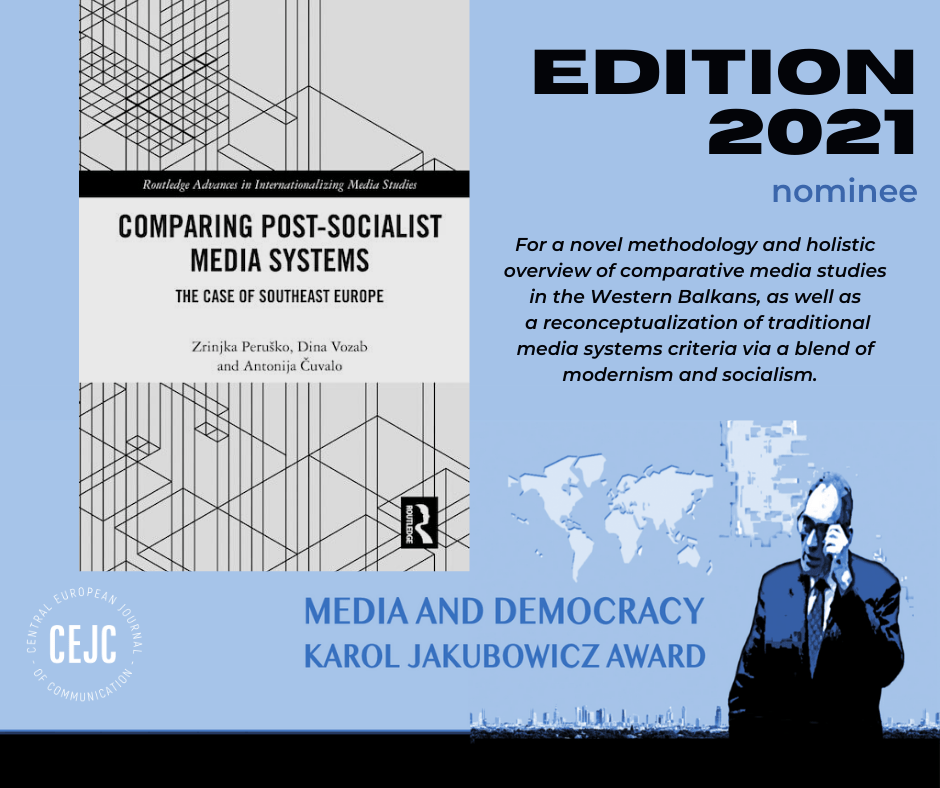
Knjiga autorica Zrinjke Peruško, Antonije Čuvalo i Dine Vozab: Comparing Post-Socialist Media Systems. The Case of South East Europe u izdanju Routledgea (New York i London) nominirana je za Nagradu za medije i demokraciju Karol Jakubowicz 2021, koja se dodjeljuje za izvanredne znanstvene doprinose u medijskim sustavima, etici, javnim medijima i kreiranju demokratske politike.
Odbor za dodjelu nagrade prepoznao je vrijednost ove knjige zbog korištenja nove metodologije i cjelovitog pregleda komparativnih studija medija na zapadnom Balkanu, kao i zbog rekonceptualizacije kriterija tradicionalnih medijskih sustava kroz mješavinu modernizma i socijalizma.
Više informacija o ovogodišnjem izdanju i svim nominiranima pronađite ovdje.
Nagrada za medije i demokraciju Karol Jakubowicz ustanovili su 2018. godine Małgorzata Semil-Jakubowicz i Poljsko udruženje za komunikaciju. Ovogodišnju dobitnicu nagrade Izborna komisija proglasit će 28. travnja – na dan godišnjice smrti dr. Karola Jakubowicza.
Book of authors Z. Peruško, A. Čuvalo and D. Vozab Comparing Post-Socialist Media Systems. The Case of South East Europe. London and New York: Routledge has been nominated to the 2021 edition of the Media and Democracy Karol Jakubowicz Award, which is granted to outstanding scholarly contributions in media systems, ethics, public service media and democratic policy-making.
More information about this year’s edition and the full list of nominees here.
The Awards Committee acknowledged the book for its new methodologies and comprehensive review of comparative media studies in the Western Balkans, as well as a reconceptualization of traditional media systems criteria via a blend of modernism and socialism.
The Media and Democracy Karol Jakubowicz Award was established in 2018 by Małgorzata Semil-Jakubowicz and the Polish Communication Association. This year’s Award winner will be announced by the Selection Committee on April, 28 – the annual anniversary of the passing of Dr. Karol Jakubowicz.
9th Graduate Spring School & Research Conference on Comparative Media Systems
co-organized with the ECREA CEE Network
Comparing Post-socialist Media Systems
IUC, Dubrovnik, 12-16 April 2021
Fully online – zoom link to follow
AGENDA (all times are in CEST)
Monday, 12 April 2021
10:00-11:00 Zrinjka Peruško, Centre for Media and Communication Research, Faculty of Political Science, University of Zagreb, Introduction to the course;
”How Media systems change: path dependency and critical junctures in comparative analysis of post-socialist media systems”
11:00-11:30 Coffee break
11:30-12:30 Helmut Scherer, Institute for Journalism and Communication Research, Hanover University of Music, Drama and Media: ”What Is a Media System and Some Other Naive Questions About Media Systems Research”
Lunch break
Tuesday, 13 April 2021
10:00-11:00 Paolo Mancini, University of Perugia
”Comparing Media Systems and the Digital Age”
11:00-11:30 Coffee break
11:30-12:30 Carmen Ciller, Universidad Carlos III de Madrid, Research Group TECMERIN, Carlos III University of Madrid: ”Modernity and emergence of global culture”
Lunch break
15:00 – 17:00 Doctoral student presentations
* Iva Bubanja, Faculty of Political Science, University of Belgrade, Serbia: ”The use of strategic framing by Serbian media in crisis reporting”
* Juraj Jerin, Faculty of Political Science, University of Zagreb, Croatia: ”Fulfillment of the Copenhagen criteria in the area of media freedom in the Western Balkans”
* Jacobo Herrero Izquierdo, University of Valladolid, Spain: ”Televisión Española and the last legislature of Adolfo Suárez (1979 – 1981)”
* Petar Čakš, Faculty of Electrical Engineering and Computer Science, University of Maribor, Slovenia: ”How regulation affects domestic music rotation–The case study of long-term consequences of implementing cultural quota on radio music in Slovenia”
Wednesday, 14 April 2021
10:00-11:00 Steffen Lepa, TU Berlin, Germany, Sophie Bruns and Helmut Scherer, University of Music, Drama and Media Hanover, Germany: ”Varieties of unfreedom: An empirically-based global media systems typology”
11:00-11:30 Coffee break
11:30-12:30 Snježana Milivojević, University of Belgrade: ”International Assistance in Transforming Media Systems in SEE”
Lunch break
15:00-17:00 Doctoral students presentations
* Bissie Anderson, University of Stirling, UK: ”A comparative analysis of global pioneer journalism ‘encoding’ practices”
* Johanna Mack, Technical University Dortmund, Germany: ”Comprehending Media Systems for Media Development Insights from Theory and Implications for Practice (With Perspectives on the Case of Guinea Bissau)”
* Lucia Mesquita, Dublin City University, Ireland: ”Should violence be considered a dimension of the Comparative Media Systems theory in the Latin American context? A longitudinal study of collaborative journalism practices in Latin American countries”
Thursday, 15 April 2021
10:00-12:00 Dina Vozab & Antonija Čuvalo, University of Zagreb, Methodological workshop: ”FsQCA – Qualitative comparative analysis of media systems using fuzzy sets”
16:00-17:30 Book launch and roundtable on Comparing post-socialist media systems: the case of Southeast Europe, London, New York:Routledge 2021
Participants:
- Katrin Voltmer, University of Leeds
- Paolo Mancini, University of Perugia
- Epp Lauk, University of Jyväskylä
- Mikhail Suslov, University of Copenhagen
- Miklos Sukosd, University of Copenhagen (convenor)
- Zrinjka Peruško, Dina Vozab, Antonija Čuvalo, University of Zagreb (the authors)
Friday, 16 April 2021
10:00-11:00 Bissera Zankova, “Media 21” Foundation: ”The Media System and Journalistic Culture in Bulgaria”
11:00-11:15 break
11:15-12:15 Lenka Vochocova, Department of Media Studies, Faculty of Social Sciences, Charles University (Prague): ”Online civic expression related to immigration in the Czech Republic: Intersection of various intolerant belief systems, populism and Euroscepticism”
12:15-12:30 break
12:30-13:30 Miklos Sukosd, Department of Communication, University of Copenhagen ”Orban’s propaganda state vs. democratic media: longue durée historical approaches to media system change in Hungary”
13:30 Closing ceremony, course evaluation, awarding of certificates
SEE ALSO:
Prijavite se na besplatni online tečaj (course) ”Praćenje cjepiva za COVID-19: Što novinari trebaju znati”/ Register now for the free online course ”Covering the COVID-19 vaccine: What journalists need to know”
U organizaciji Knight Centra za novinarstvo Amerika, Sveučilišta Teksas iz Austina, od 29. ožujka do 25. travnja 2021, pod vodstvom Maryn McKenne
Organized by Knight Center for Journalism in the Americas, Texas University, Austin, March 29 – April 25, 2021. led by Maryn McKenna
Dobrodošli u novi opći otvoreni online tečaj Knight Centra, “Praćenje cjepiva za COVID-19: što novinari moraju znati.” Tijekom ovog četverotjednog tečaja studenti će naučiti kako poboljšati praćenje (pokrivanje, izvještavanje) o COVIDu-19 i cjepivima. Studenti će čuti vodeće znanstvene novinare i medicinske stručnjake koji će razgovarati o učinkovitosti različitih formula cjepiva, analizirati raspodjelu cjepiva, podijeliti savjete za uklanjanje dezinformacija i izostanka informacija tijekom praćenja cjepiva i još mnogo toga.
”Ovaj višejezični opći otvoreni online tečaj (istovremeno će biti dostupan na engleskom, španjolskom, portugalskom i francuskom) pomoći će novinarima novinarima širom svijeta koji pokušavaju bolje razumjeti znanost koja stoji iza cjepiva, uvođenje i distribuciju svakog cjepiva, pogrešne informacije oko cjepiva i još mnogo toga”, rekla je Mallary Tenore, zamjenica ravnatelja Knight Centra za novinarstvo u Amerikama.
Opći otvoreni internetski tečaj vodit će zdravstvena i znanstvena novinarka Maryn McKenna, koja je ujedno i viša suradnica u Centru za proučavanje ljudskog zdravlja na Sveučilištu Emory.
Ovdje saznajte više o tečaju, “Praćenje cjepiva za COVID-19: Što novinari moraju znati”, uključujući kako se registrirati. Prijavite se danas za ovaj besplatni tečaj!
Welcome to the Knight Center’s new MOOC, “Covering the COVID-19 vaccine: What journalists need to know.” During this four-week massive open online course, students will learn how to improve their coverage of COVID-19 and the vaccines. Students will hear from leading science journalists and medical experts who will discuss the efficacy of different vaccine formulas, analyze the distribution of vaccines, share tips for dispelling disinformation and misinformation when covering the vaccines, and much more.
This multilingual MOOC (Massive Open Online Course) will help journalists around the world who are trying to better understand the science behind the vaccines, the rollout and distribution of each vaccine, misinformation surrounding the vaccines, and much more,” said Mallary Tenore, associate director of the Knight Center for Journalism in the Americas.
The Massive Open Online Course (MOOC) will be taught by health and science journalist Maryn McKenna, who is also a Senior Fellow at the Center for the Study of Human Health at Emory University.
Learn more about the MOOC, “Covering the COVID-19 vaccine: What journalists need to know,” here, including how to register. Sign up today for this free course!
Poduprite UNICEF-ovu kampanju protiv nasilja nad novinarkama / Support the campaign against violence against woman journalists
UNESCO will launch a campaign on online violence against women journalists this 8 March for International Women’s Day.
In a recent UNESCO-ICFJ survey, 73% of the women journalists surveyed reported having faced online violence while doing their job. They are often targeted in coordinated misogynistic attacks.
This violence harms women’s right to speak and society’s right to know. To tackle this increasing trend, we need to find collective solutions to protect women journalists from online violence. This includes strong responses from social media platforms, national authorities and media organizations.
The campaign will highlight key results from the UNESCO-ICFJ global survey on online violence against women journalists, which were published last December in the report ‘Online violence against women journalists: a global snapshot of incidence and impacts’ (now also available in French, Spanish, and Arabic).
Online violence against women journalists harms everyone. Let’s end it!
#JournalistsToo
9th Graduate Spring School & Research conference on Comparative Media Systems
co-organized with the ECREA CEE Network
Comparing Post-socialist Media Systems
Inter University Center, Dubrovnik, Croatia, 16-21 April 2021, Blendend In person & Online post-graduate course and research conference
In Central and Eastern Europe it is 30 years since the socialist regimes collapsed, and democracy was introduced. The theoretical framework of the “transition” is no longer employed, even the “consolidation” discourse and approach is over. Can we pronounce the media systems in this region of the world to have acquired a settled shape, a form/character that is durable and stable?
The thirty years of transformation have been diverse. The same original critical juncture of the fall of socialism has been differently used and shaped by different actors, countries or institutions, to produce different results. Not only is there a division of CEE into those who are now members of the EU and those who are not, but there is also a division between those who have consolidated some level of democracy and those who have consolidated some degree of authoritarian regimes. The authoritarian backsliding is a fact that can no longer be treated as a phase in the consolidation of democracy, but must also be recognized as one type of result of the transformations. A new critical juncture will be necessary in order to re-start developments along the road to consolidated democracy. What shaped these diverse developments? Why did some countries consolidate democracy, and others have hybrid or authoritarian regimes? How do these changes compare to the changes of other European media systems? Should we compare media systems or media cultures? We will in this course and research conference examine conditions and variables of media change from modernization to socialism, and from socialism to post-socialism. We will explore ways to study change in media systems, focusing both on the temporal and spatial frames, and will examine transformations necessary in the political, economic and cultural fields. And we will examine which combination of historical conditions from the longue durée or more recently, are responsible for certain types of outcomes of media systems.
The course includes a one day hands-on methodological workshop on the design and implementation of fuzzy set QCA and the accompanying statistical analysis, held by Dina Vozab and Antonija Čuvalo from the University of Zagreb.
The course is organized by course directors from 7 European universities:
Zrinjka Peruško, University of Zagreb, Croatia
Carmen Ciller, Universidad Carlos III de Madrid, Spain
Steffen Lepa, Technische Universität Berlin, Germany
Paolo Mancini, Università di Perugia, Italy
Snježana Milivojević, University of Belgrade, Serbia
Slavko Splichal, University of Ljubljana, Slovenia
Miklós Sükösd, University of Copenhagen, Denmark
This year’s lecturers include:
• Carmen Ciller, Universidad Carlos III de Madrid, Spain
• Steffen Lepa, Technische Universität Berlin, Germany
• Paolo Mancini, Università di Perugia, Italy
• Snježana Milivojević, University of Belgrade, Serbia
• Helmut Scherer, Institut für Journalistik und Kommunikationsforschung of the Hochschule für Musik, Theater und Medien Hannover
• Zrinjka Peruško, University of Zagreb, Croatia
• Miklós Sükösd, University of Copenhagen, Denmark
• Lenka Vochocová, Department of Media Studies, Charles University, Prague
This 9th “slow science” IUC-CMS is an interdisciplinary research conference & post-graduate course open to academics, doctoral and post-doctoral students in media, communication and related fields engaged with the issue of media and media systems, that wish to discuss their current work with established and emerging scholars and get relevant feedback.
Invited research conference participants will deliver keynote lectures with ample discussion opportunities. In this unique academic format, student course attendees will have extended opportunity to present and discuss their current own work with the course directors and other lecturers and participants in seminar form (English language) and in further informal meetings around the beautiful old-town of Dubrovnik (UNESCO World Heritage) over 5 full working days (Monday to Saturday).
The working language is English.
Participation in the course for graduate (master and doctoral) students brings 3,5 ECTS credits, and for doctoral students who present their thesis research 6 ECTS. The course is accredited and the ECTS are awarded by the Faculty of Political Science, University of Zagreb (www.fpzg.unizg.hr). All participants will also receive a certificate of attendance from the IUC.
Enrolment
To apply, send a CV and a motivation letter to zrinjka.perusko@gmail.com Students who wish to present their research should also send a 300 word abstract. The course can accept 20 students, and the applications are received on a rolling basis. After notification of acceptance you need to register also on this web page https://iuc.hr/programme/1077. The IUC requires a small enrolment fee from student participants. Participants are responsible for organizing their own lodging and travel. Affordable housing is available for IUC participants. Stipends are available from IUC for eligible participants, further information at https://www.iuc.hr/iuc-support.php. For information on these matters please contact the IUC secretariat at iuc@iuc.hr.
Venue Information
The Inter-University Centre was founded in Dubrovnik in 1972 as an independent, autonomous academic institution with the aim of promoting international co-operation between academic institutions throughout the world. Courses are held in all scientific disciplines around the year, with participation of member and affiliated universities.
Additional Information
For further information about academic matters please contact the organizing course director: professor Zrinjka Peruško zrinjka.perusko@gmail.com, Centre for Media and Communication Research (www.cim.fpzg.unizg.hr), Department of Media and Communication, Faculty of Political Science (www.fpzg.unizg.hr), University of Zagreb (www.unizg.hr).
Zrinjka Peruško (2021) Public Sphere in Hybrid Media Systems in Central and Eastern Europe, Javnost – The Public. DOI:10.1080/13183222.2021.1861405
The article explores the concept of hybridity in relation to political and media-related change and its implications for the contemporary public sphere in Central and Eastern Europe. Two key approaches to hybridity are contrasted and examined to this end: the well-established concept of the hybrid media system, defined in terms of a combination of older and newer media logics in platform societies in the times of late modernity, is con- trasted with the concept of hybridity in political and media systems in relation to unsuccessful regime change and democratization or recent illiberal backsliding. Hybridity as the outcome of longue durée contextual conditions, as well as the more recent mediatization, is present also in the contemporary public spheres in CEE countries in relation to specific conditions and contingencies of individual mediascapes.
https://www.tandfonline.com/eprint/NGDPXWNGP33Q5DUPWJVM/full?target=10.1080/13183222.2021.1861405
Poziv na objavu radova: Nordic Journal of Media Studies 2022
CALL FOR PAPERS: Nordic Journal of Media Studies 2022
Title: Media Events in the Age of Global, Digital Networks
Special issue editors: Kirsten Frandsen (Aarhus University), Anne Jerslev (University of Copenhagen), Mette Mortensen (University of Copenhagen)
Deadline for submission of abstracts: February 15, 2021
The 2022 volume of Nordic Journal of Media Studies focuses on the technological, commercial, social, cultural, and political dynamics shaping current media events in today’s connective media landscape distinguished by blurred boundaries between media production and consumption. We are specifically interested in the role of social media in the construction of current media events, but also welcome analyses with other perspectives on the digital condition, including for instance the increasingly complex interplay between media in current media events. This may also include analyses of the disruption of media events caused by crises such as Covid-19, which might shed new light on important aspects of media events.
This volume seeks contributions that further the theoretical, empirical, and methodological approaches to understanding and studying media events. Subjects include, but are not limited to, the following:
The algorithmic and commercial underpinnings of media events Media events and the construction of the spectacular Social media and the construction and production of mega events Media events and eventification – conceptual challenges?
- Eventification as a marketing strategy
- Eventification and everyday life
- Audience experiences and strategies
- The configuration of time and place in media events
- Media events between the singular and the repetitive Covid-19, de-eventification, and emergence of new communicative events
- The Internet, media events, and globalisation
- Media events from a Nordic perspective
- The media dynamics of political scandals and terrorist attacks
- Media events and mediatised rituals – integrative and disruptive functions
Please submit proposals of 500 words to the editors of this themed issue:
Kirsten Frandsen (imvkf@cc.au.dk) Anne Jerslev (jerslev@hum.ku.dk) Mette Mortensen (metmort@hum.ku.dk)
A selection of authors will be invited to submit full papers (maximum 8,000 words). Please note that acceptance of an abstract does not guarantee publication, given that all papers will undergo double-blind peer review. For questions, please contact the editors of this theme issue.
Timetable
Deadline for abstracts: 15 February 2021. Notification to authors: 1 March 2021. Deadline for submission of full papers: 1 August 2021. Peer-review process: 1 August–15 October 2021. Submission of final manuscript: 1 January 2022. Publication of special issue: spring/summer 2022.
View this Call for papers on Nordicom’s website:
https://www.nordicom.gu.se/sv/aktuellt/nyheter/call-papers-nordic-journal-media-studies-2022
No payment from the authors will be required.
Poziv na sudjelovanje u istraživanju o upotrebi vijesti
Centar za istraživanje medija i komunikacije Fakulteta političkih znanosti Sveučilišta u Zagrebu provodi istraživanje o upotrebi vijesti u Hrvatskoj pod vodstvom prof.dr.sc. Zrinjke Peruško. Istraživanje financira Sveučilište u Zagrebu. Ovo istraživanje pomoći će nam da razumijemo kako upotreba vijesti i informativnih medija utječe na razumijevanje svijeta i demokratskog procesa. Zato bismo željeli da s nama podijelite kako koristite vijesti i informativne medije u svakodnevnom životu – koje izvore pratite, koje su vam vijesti važne, koliko imate u njih povjerenja, itd. Istraživanje se odnosi na tri grada- Zagreb, Split i Slavonski Brod, pa vam molimo da nam se javite e-mailom ako živite u jednom od tih gradova i voljeli biste sudjelovati u istraživanju (cimfpzg.2007@gmail.com). Traže se ispitanici iz tri dobne skupine: od 18 do 34, 35 do 61 i stariji od 61 godine.
Istraživanje je anonimno – iako će se intervju (radi epidemije COVID 19) odvijati online putem programa MS Teams i biti sniman, ti će podaci biti sigurno pohranjeni na Fakultetu političkih znanosti u skladu s EU pravilima o zaštiti tajnosti podataka. Vaše ime niti bilo koja druga identifikacija (slika, glas) neće biti vidljivi u rezultatima istraživanja ili objavljenim radovima. Većina informacija koje dobijemo od vas putem intervjua bit će korišteno u agregiranom obliku tj. kako dio grupnih informacija o načinima upotrebe vijesti. Pojedini citati koje ćemo možda koristiti u analizama će biti prikazani pod pseudonimom gdje će vaše stvarno ime biti zamijenjeno nekim drugim (na primjer: „Najviše povjerenja imam u televizijske vijesti televizije XX zato što su objektivne i nepristrane, i prate upravo one teme koje su mi najvažnije u svakodnevnom životu“ (Mila, 35-50, Split).
Intervju će trajati oko 90 minuta. Za sudjelovanje ćemo vas nagraditi bonom za dućan opće prehrane u iznosu od 200 kuna. Intervjui će se odvijati u prosincu 2020 i siječnju 2021, u vremenu koje odgovara ispitaniku/ci. Članice istraživačkog tima će se prije početka intervjua telefonom o svemu dogovoriti s ispitanicima i uputiti ih (ili njihove pomagače u upotrebi kompjutora) u to kako koristiti MS Teams program za video komunikaciju.
Za sudjelovanje u istraživanju i sva pitanja možete se obratiti na email: cimfpzg.2007@gmail.com.
PROMOCIJA KNJIGE “COMPARING POST-SOCIALIST MEDIA SYSTEMS: THE CASE OF SOUTHEAST EUROPE”
U sklopu Hrvatskih politoloških razgovora 2020. godine održan je razgovor povodom izlaska knjige Zrinjke Peruško, Dine Vozab i Antonije Čuvalo: Comparing Post-Socialist Media Systems: The Case of Southeast Europe. Promocija je održana online, 6.11.2020. od 18:00 do 19:15. Razgovor je moderirao Zlatan Krajina, a o knjizi su govorili Zrinjka Peruško, Dejan Jović i Tihomir Cipek s Fakulteta političkih znanosti iz Zagreba i Snježana Milivojević s Fakulteta političkih nauka u Beogradu.
Snimku razgovora o knjizi možete pogledati ovdje:
Isječke iz knjige i recenzije možete pročitati ovdje:https://www.routledge.com/Comparing-Post-Socialist-Media-Systems-The-Case-of-Southeast-Europe/Perusko-Vozab-Cuvalo/p/book/9780367226770
PROMOCIJA KNJIGE, 6. studenog u 18,00 sati – o n l i n e
Zrinjka Peruško, Dina Vozab i Antonija Čuvalo: Comparing Post-Socialist Media Systems: The Case of Southeast Europe. The Case of Southeast Europe.
Drage kolegice i kolege,
pozvani ste na razgovor povodom izlaska knjige Zrinjke Peruško, Dine Vozab i Antonije Čuvalo: Comparing Post-Socialist Media Systems: The Case of Southeast Europe. Promocija će biti održana online, 6.11.2020. od 18:00 do 19:15. O knjizi će govoriti profesori/ce s Fakulteta političkih znanosti iz Zagreba i Fakulteta političkih nauka u Beogradu.
Razgovor se održava u sklopu Hrvatskih politoloških razgovora koji će se održati u petak i subotu 6. i 7. studenog 2020. Program i obrazac za prijavu sudjelovanja nalaze se na ovoj poveznici:
http://www.politologija.hr/hr/konferencija/poziv-na-sudjelovanje-politoloski-razgovori-2020-9
Informacije o knjizi mogu se pronaći na ovoj poveznici:
OPIS KNJIGE I RECENZIJE
This book explains divergent media system trajectories in the countries in southeast Europe, and challenges the presumption that the common socialist experience critically influences a common outcome in media development after democratic transformations, by showing different remote and proximate configuration of conditions that influence their contemporary shape.
Applying an innovative longitudinal set-theoretical methodological approach, the book contributes to the theory of media systems with a novel theoretical framework for the comparative analysis of post-socialist media systems. This theory builds on the theory of historical institutionalism and the notion of critical junctures and path dependency in searching for an explanation for similarities or differences among media systems in the Eastern European region.
Extending the understanding of media systems beyond a political journalism focus, this book is a valuable contribution to the literature on comparative media systems in the areas of media systems studies, political science, Southeast and Central European studies, post-socialist studies and communication studies.
This is a conceptually rich, methodologically sophisticated, and interdisciplinary analysis of south-east European media systems that explains continuity, change and divergence between the six cases. It deserves to be read not only by scholars of the region but by those considering how to approach more generally the study of comparative media systems and cultures.
– John Downey, Professor of Comparative Media Analysis, Loughborough University
There was the need to fill a gap in the study of media systems in Southeast Europe. This book is doing this in a very convincing way. Peruško and colleagues support their discussion of the media systems in Southeast Europe with a rich and often complex interpretative apparatus deriving both from media studies and political science. Undoubtedly this mixture represents a major enrichment of their attempt that opens the doors to other possible applications, avoiding the frequent self-reference that often characterizes media studies.
– Paolo Mancini
This book reveals major changes in media systems in the six post-socialist countries of Southeast Europe between their early development in the late 19th century and the end of the socialist period (1945-1990) after World War II, and the breakup of their common state of Yugoslavia (1918-1990). The authors follow common threads of changes in contemporary media policy and media systems from the prolific challenges they pose to democracies to the appalling combination of conditions that reinforce media dependence on agents of political and economic power in what they call a “hybrid and competitive authoritarian media systems”. This is an important contribution to comparative media studies, providing an exciting insight into media culture across diverse national contexts and advancing a theoretical understanding of the complex and little-known changes in the post-socialist countries of the former Yugoslavia.
– Slavko Splichal, University of Ljubljana
Peruško, Vozab and Čuvalo’s book focusing on one of the most troubled regions of European history is an important contribution to the study of comparative media systems. Taking an interdisciplinary approach, this excellent study offers historical depth, conceptual innovation and methodological sophistication and will be a benchmark for future comparative research in the field. A fascinating read for everybody interested in the transformation of media systems in emerging democracies!
– Katrin Voltmer, Professor of Communication and Democracy, University of Leeds
NOVI PROJEKT CENTRA ZA ISTRAŽIVANJE MEDIJA I KOMUNIKACIJE
POTROŠNJA VIJESTI KAO DEMOKRATSKI RESURS
Novi projekt CIM-a kojeg financira Sveučilište u Zagrebu (2020) je Q istraživanje: Potrošnja vijesti kao demokratski resurs. U predloženom istraživanju istražit ćemo obrasce potrošnje vijesti kao demokratskog resursa kao nastavak istraživanja iz provedenog krajem 2014. godine u okviru međunarodne istraživačke studije „Potrošnja vijesti kao demokratski resurs u kros-kulturnom istraživačkom projektu“. Rezultati istraživanja hrvatskih publika vijesti iz 2014. objavljeni su u časopisu Participations (Peruško i dr., 2017). Novo istraživanje provodi se pod vodstvom prof.dr.sc. Zrinjke Peruško uz sudjelovanje doc.dr.sc. Antonije Čuvalo, doc.dr.sc. Dine Vozab, Jasmine Jovev, Ane Hećimović i Barbare Mašić.
Istraživanje će otkriti profile i tipologije potrošnje vijesti i građanskog angažmana. Središnja istraživačka pitanja povezana su s interakcijom različitih obrazaca potrošnje vijesti i demokratskim praksama koje obuhvaćaju participaciju, deliberaciju i donošenje političkih odluka. Ovo će biti drugi put da se u Hrvatskoj provodi analiza obrazaca potrošnje vijesti kod medijskih publika Q metodom te stoga ovo istraživanje nudi i inovaciju u smislu longitudinalne usporedbe kvalitativnih podataka. Q metoda koristi se za rigorozno i sistematsko istraživanje dimenzija ili tipologija subjektivnih fenomena: mišljenja, uvjerenja i stavova kako bi se ustanovile distinktivna obilježja pojedinaca koji dijele zajednička stajališta u odnosu na neku temu (Davis i Michelle 2011, Lai i sur. 2007, Steelman i Maguire 1999).
Uobičajeni obrasci potrošnje vijesti, kao i povjerenje u medije te medijska recepcija temeljno su transformirani novim medijskim tehnologijama. Medijske organizacije koje su bile tradicionalni pružatelji vijesti gube svoju privilegiranu poziciju kod medijskih publika (Newman i dr., 2020). Budući da su vijesti važan resurs za informiranje i deliberaciju o javnim pitanjima, ovakva transformacija ima posljedice za oblike građanskog angažmana (Boulianne, 2016). Izvještaji o stanju medijske industrije i razvoju publika u Hrvatskoj (https://cim.fpzg.unizg.hr/) jasno pokazuju kako je hrvatska medijska industrija trenutno u stanju transformacije.
Predloženo istraživanje će produbiti saznanja o promijenjenim obrascima potrošnje vijesti u Hrvatskoj. Rezultati će se usporediti s prethodno provedenom Q studijom o repertoarima vijesti (Peruško i dr., 2017). Također će se usporediti s provedenim anketnim istraživanjima Centra za istraživanje medija i komunikacije iz 2013 („Europske medijske publike“ u okviru COST mreže Transforming Audiences, Transforming Societies), 2014 („Medijske publike: nove medijske navike i politička participacija“, na hrvatskom reprezentativnom uzorku, te s istraživanjima digitalnih publika vijesti Reutersovog instituta za istraživanje novinarstva na kojima je CIM hrvatski partner.
New project of the Center for Media and Communication Research
News Consumption as a Democratic Resource
Q Study: News Consumption as a Democratic Resource is the new research project that has been approved for funding by the University of Zagreb in 2020. The study will explore patterns of news consumption as a democratic resource as a continuation of research conducted in late 2014 as part of the international research study “News consumption as a democratic resource in a cross-cultural research project.” The results of a survey of Croatian news audiences from 2014 were published in the journal Participations (Peruško et al., 2017). The study is led by professor Zrinjka Peruško, with the participation of assistant professors Antonija Čuvalo and Dina Vozab and PhD students Jasmina Jovev, Ana Hećimović and Barbara Mašić.
The study will reveal profiles and form typologies of news use and civic engagement. Central research issues are related to the interaction of different patterns of news consumption and democratic practices that include participation, deliberation, and policy making. This will be the second time that an analysis of news consumption patterns in media audiences has been conducted in Croatia using the Q method, and therefore this research also offers innovation in terms of longitudinal comparison of qualitative data. The Q method is used to rigorously and systematically investigate the dimensions or typologies of subjective phenomena: opinions, beliefs, and attitudes to establish the distinctive features of individuals who share common views on a topic (Davis and Michelle 2011; Lai et al. 2007, Steelman et al. Maguire 1999).
The usual patterns of news consumption, as well as trust in the media and media reception have been fundamentally transformed by new media technologies. Media organizations that have been traditional news providers are losing their privileged position among media audiences (Newman et al., 2020). Because news is an important resource for information and deliberation on public issues, this transformation has implications for forms of civic engagement (Boulianne, 2016). Reports on the state of the media industry and the development of audiences in Croatia (https://cim.fpzg.unizg.hr/) clearly show that the Croatian media industry is currently in a state of transformation.
The proposed research will deepen the knowledge about the changed patterns of news consumption in Croatia. The results will be compared with a previously conducted Q study on news repertoires (Peruško et al., 2017). It will also be compared with the surveys conducted by the Center for Media Research and Communication from 2013 (“European Media Audiences” within the COST network Transforming Audiences, Transforming Societies), 2014 (“Media Audiences: New Media Habits and Political Participation”) in the Croatian representative sample, and with digital audience surveys from the Reuters Institute for Journalism Research, in which CIM is a Croatian partner.
REUTERS Digital News Report 2020
Izvori vijesti u Hrvatskoj 2020: 78% građana koristi pametne telefone
Zrinjka Peruško
Centar za istraživanje medija i komunikacije (CIM)
Već četvrtu godinu Centar za istraživanje medija i komunikacije Fakulteta političkih znanosti Sveučilišta u Zagrebu sudjeluje u istraživanju Digitalnih vijesti Reuters instituta za istraživanje novinarstva Sveučilišta Oxford. Najnoviji Izvještaj o digitalnim vijestima 2020 objavljen je danas, te ga donosimo u cijelosti na ovom linku: Digital News Report
Globalna pandemija korona virusa ubrzala je već vidljive trendove pomaka prema digitalnim izvorima vijesti i upotrebi mobilnih medija i medijskim platformama. Ovogodišnje istraživanje provedeno je u 40 zemalja svijeta anketom u veljači 2020, prije nastupanja epidemije, ali su u nekim zemljama podaci ponovo prikupljeni u travnju što omogućava uvid u navedeno ubrzanje. U svijetu je naglašen i trend povećanja plaćanja za online vijesti – u SAD-u se već u siječnju dogodio skok od 4% do 20%, dok u Norveškoj čak 42% korisnika plaća online vijesti.
U prilogu su i rezultati za Hrvatsku, gdje se vidi da nema puno promjene u glavnim izvorima vijesti za hrvatske građane. Od tradicionalnih medija komercijalne televizije s nacionalnom koncesijom su uz HRT na prvom mjestu, a uz njih 24 sata, Jutarnji list i Otvoreni radio, dok su ostali tradicionalni mediji izvori vijesti za manje od 20% građana. Online mediji su ipak češće izvori vijesti za hrvatske građane: nakon Index.hr na kojem vijesti traži čak 61% publika, slijede online stranice tradicionalnih medija.
Upotreba vijesti kontinuirano opada od 2017 godine, kad je Hrvatska prvi puta sudjelovala u istraživanju. Do izjednačenja telefona i televizora kao glavnih platformi za dobavu vijesti dolazi u Hrvatskoj već tijekom 2018 godine, da bi u 2020 ta razlika već bila značajna – 78% građana vijesti čita/gleda/sluša na pametnim telefonima, a 65% na televizoru. Nastavlja se i trend većeg povjerenja u matične (mainstream) medije, dok mediji na lijevom i desnom spektru imaju niže postotke povjerenja (Index.hr dosta visokih 55% povjerenja, ali 24% nepovjerenja, dok Dnevno.hr ima 48% povjerenja i 25% nepovjerenja).
Izvještaj za Hrvatsku se može pročitati ovdje: Digital News Report 2020 Hrvatska Iscrpnija analiza trendova i rezultata za Hrvatsku bit će objavljena u rujnu.
IUC Comparative Media Systems 2020 cancelled
We regret to inform you that the spring course Comparative Media Systems 2020 at Inter University Centre in Dubrovnik, which was scheduled for the week April 14th-19th, is cancelled due to the COVID-19 situation. All the other courses at the IUC in April are cancelled as well. We thank all the students who applied for the course and hope we will meet at the same course another time.
On behalf of the course organization team, professor Zrinjka Peruško.
Istraživački novinarski laboratorij: Vjerodostojnost medija kroz kulturu eksperimenta i inovacije u redakcijama
Istraživački tim s Fakulteta političkih znanosti pokrenuo je projekt pod nazivom “ISTRAŽIVAČKI NOVINARSKI LABORATORIJ: VJERODOSTOJNOST MEDIJA KROZ KULTURU EKSPERIMENTA I INOVACIJE U REDAKCIJAMA”. Realizaciju projekta skraćenog naziva “JOURLAB” financira Hrvatska zaklada za znanost (HRZZ) u iznosu od 525.070,50 kuna, a riječ je o projektu kojemu je cilj tijekom naredne četiri godine uspostaviti novinarski laboratorij na Fakultetu političkih znanosti Sveučilišta u Zagrebu.
Bit će to prvi laboratorij te vrste u Hrvatskoj u kojem će se proizvoditi i testirati nove novinarske forme i informativni oblici po uzoru na primjere dobre prakse na vrhunskim sveučilištima u SAD-u i Europi. U sklopu projekta provest će se i sveobuhvatno istraživanje medijskih sadržaja u Hrvatskoj, kao i istraživanje percepcije
medijskih publika te istraživanje na praktičarima unutar hrvatskih medijskih redakcija. Također, provest će se i mapiranje inovativnih novinarskih praksi u međunarodnom kontekstu, a članovi istraživačkog tima sve će navedene faze projekta prezentirati na njegovom javnom predstavljanju.
RASPORED:
10:00 Uvodni govor dekana Fakulteta političkih znanosti prof. dr. sc. Zorana Kurelića i voditeljice projekta prof. dr. sc. Tene Perišin
10:15 Prezentacija projekta po fazama
Analiza sadržaja hrvatskih medija – mag. nov. Stela Lechpammer
Istraživanje percepcija medijskih publika i novinarskih praksi u hrvatskim redakcijama – izv. prof. dr. sc. Igor Kanižaj
Istraživanje novih novinarskih praksi: Solutions novinarstvo i konstruktivno novinarstvo – mag. nov. Petra Kovačević
Nove novinarske forme i informativni oblici – prof. dr. sc. Tena Perišin
10:45 Rasprava o projektu
Izbori za EU parlament i digitalne vijesti: objavljeni novi izvještaji
Euroflections izvještaj o proteklim izborima za EU parlament, uključuje 70 tekstova više od 75 svjetskih znanstvenika. Izvještaj možete skinuti na sljedećoj poveznici https://euroflections.se/. Ovaj znanstveni izvještaj uredili su Niklas Bolin, Kajsa Falasca, Marie Grusell i Lars Nord s Mid Sweden University.
Reuters Institute Digital News Report 2019, koji su uredili Nic Newman, Richard Fletcher, Antonis Kalogeropoulos i Rasmus Kleis Nielsen s Oxford University. Ovo je osmi uzastopni izvještaj i ove godine uključuje analize trendova upotrebe vijesti u medijskim tržištima 38 zemalja svijeta, uz komparativne analize međunarodnih trendova uključujući odnos populizma i upotrebe vijesti. Izvještaj možete skinuti na sljedećoj poveznicihttps://reutersinstitute.politics.ox.ac.uk/sites/default/files/2019-06/DNR_2019_FINAL_0.pdf
EU COST Action New Exploratory Phase in Research on East European Cultures of Dissent (NEP4DISSENT)
8th Graduate Spring School & Research conference on Comparative Media Systems
100 Years of Media Systems in Southeast Europe – the legacy of Yugoslavia
Inter University Center, Dubrovnik, Croatia, 15-20 April 2019
In cooperation with the ECREA CEE Network

AGENDA
Monday, 15 April 2019
9:30-11:00 Zrinjka Peruško, University of Zagreb
Introduction to the course & the EU COST Action New Exploratory Phase in Research on East European Cultures of Dissent (NEP4DISSENT)
Path dependency and critical junctures in comparative analysis of post-socialist media systems: the case of Southeast Europe
11:00-11:30 Coffee break
11:30-13:00 Zlatan Krajina, University of Zagreb
Media at the periphery
Lunch break
15:00-17:00 Film & discussion
Igor Mirković Sretno dijete – Documentary on new wave in music, Yugoslavia in the 1980’s
Tuesday, 16 April 2019
9:30-11:00 Paolo Mancini, University of Perugia
Media Systems in Central Eastern Europe: Between Institutionalism and Culture
11:00-11:30 Coffee break
11:30-13:00 Carmen Ciller, Universidad Carlos III de Madrid
Authoritarian experiences in Franco´s and Post Franco´s dictatorship: film and media in Spain
Lunch break
Doctoral student presentations
15:00 – 17:00
Snežana Bajčeta, University of Belgrade, Faculty of Political Sciences
How does legacy work in platform society?
Journalism between media and platforms in Southeast Europe
Dren Gerguri, University of Pristina
Media Systems research and post-Yugoslavian states: Case of Kosovo
Ana Hečimović, University of Zagreb
Media pluralism and diversity in six Southeast European countries
Wednesday, 17 April 2019
9:30-11:00 Antonija Čuvalo & Dina Vozab, University of Zagreb
Socialism as a factor of convergence or divergence: comparing media systems of socialist Yugoslavia
11:00-11:30 Coffee break
11:30-13:00 Snježana Milivojević, University of Belgrade
Legalizing freedom of speech: history of press/media legislation in Yugoslavia
Lunch break
Thursday, 18 April 2019
9:30-11:00 Marko Zubak, Croatian Institute of History, Zagreb
Yugoslav Youth Press: Communist Alternative Media
11:00-11:30 Coffee break
11:30-13:00 Vlatko Ilić, Faculty of Dramatic Arts, Belgrade
Representing Queerness: Yugoslavian and Post-Yugoslavian Media
Lunch break
15:00-16:30 Tarik Jusić, University of New York in Prague (UNYP)
Transplanting (In)dependent Media: Lessons from International Media Assistance in the Western Balkans
16:30-16:45 break
16:45 – 17:45 Aleksandra Dragojlov, Cardiff University
Genuine Domestic Change or Fake Compliance? The Pervasiveness of Politics in the Serbian Media Sector
Friday, 19 April 2019
9:00-13:00 Dina Vozab & Antonija Čuvalo, University of Zagreb
Methodological workshop: fsQCA – Qualitative comparative analysis of media systems using fuzzy sets (with one coffee break)
13:00 – 13:30 Closing ceremony, course evaluation, awarding of certificates
8th Graduate Spring School & Research conference on Comparative Media Systems
100 Years of Media Systems in Southeast Europe – the legacy of Yugoslavia
Inter University Center, Dubrovnik, Croatia, 15-20 April 2019
In cooperation with the ECREA CEE Network and EU COST Action New Exploratory Phase in Research on East European Cultures of Dissent (NEP4DISSENT)
In October/December 2018 a 100 year anniversary of the first Yugoslavia passed with hardly any examination of its impact in its successor countries. In this research conference and graduate spring school we wish to examine the legacy of Yugoslavia in the present day media systems in the countries of the region. How can we explain their divergent media systems trajectories in the countries which spent 70-ish years in a shared state? Why is it that the freedom of expression, independence and autonomy of the media in the countries in the region exhibit consistently lower scores then in the countries of Central Europe, almost 30 years after the beginning of post-communist democratic transition? How do these post-communist media systems compare to media systems in western democracies, and can commonalities be found in sufficient degree so that they might be included in the same typology? Or, are these media systems so marked by their communist antecedents that they merit the special type of “post-communist media system”?
If we wished to explore the influence of socialism/communism, the likelihood of a single model of media system is most likely in southeastern Europe as these countries, having been part of one common state, would be expected to have had the most similar socialist experience. The differences in the historical and political development of the constituent states prior to the common Yugoslavian experience, and the political developments after the dissolution of the socialist Yugoslavia in 1990s, however, speak more to the contrary. The course & research conference will explore the influences from a historical institutionalist perspective (Peruško 2016). Present day media systems in Slovenia, Croatia, Bosnia and Herzegovina, Serbia, Montenegro and Macedonia will be analyzed with this comparative longitudinal optics.
A special focus will be put on the socialist experience with the media in Yugoslavia, the differences or similarities of media agendas and strategies within different republics. The examples and cases of dissent in the media and popular culture will also be examined. The course will examine comparative examples from other European regions that at one time in the past 100 years were at the periphery of Europe, especially the Mediterranean countries.
The course includes a one day hands-on methodological workshop on the design and implementation of fuzzy set QCA and the accompanying statistical analysis.
Course organization & keynote lecturers
The course is organized by course directors from 6 European universities:
Carmen Ciller, Universidad Carlos III de Madrid, Spain
Steffen Lepa, Technische Universität Berlin, Germany
Paolo Mancini, Università di Perugia, Italy
Snježana Milivojević, University of Belgrade, Serbia
Zrinjka Peruško, University of Zagreb, Croatia
Slavko Splichal, University of Ljubljana, Slovenia
Confirmed keynotes include Paolo Mancini, University of Perugia, Zrinjka Peruško, University of Zagreb, Antonija Čuvalo, University of Zagreb, Dina Vozab, University of Zagreb, Snježana Milivojević, University of Belgrade, Slavko Splichal, University of Ljubljana, Snezana Trpevska, Institute of Communication Studies, Skopje, Tarik Jusić, Analitika, Sarajevo, Marko Zubak, Croatian Institute of History, Zagreb, Vlatko Ilić, Faculty of Dramatic Arts, Belgrade, Kaarle Nordestreng, University of Tampere (tbc), Carmen Ciller, Universidad Carlos III de Madrid.
This eight “slow science” IUC-CMS is an interdisciplinary research conference & post-graduate course open to academics, doctoral and post-doctoral students in media, communication and related fields engaged with the issue of media and media systems, that wish to discuss their current work with established and emerging scholars and get relevant feedback.
Invited research conference participants will deliver keynote lectures with ample discussion opportunities. In this unique academic format, student course attendees will have extended opportunity to present and discuss their current own work with the course directors and other lecturers and particpants in seminar form (English language) and in further informal meetings around the beautiful old-town of Dubrovnik (UNESCO World Heritage) over 5 full working days (Monday to Saturday).
The working language is English.
Participation in the course for graduate (master and doctoral) students brings 3,5 ECTS credits, and for doctoral students who present their thesis research 6 ECTS. The course is accredited and the ECTS are awarded by the Faculty of Political Science, University of Zagreb (www.fpzg.unizg.hr). All participants will also receive a certificate of attendance from the IUC.
Enrolment
To apply, send a CV and a motivation letter to zrinjka.perusko@gmail.com Students who wish to present their research should also send a 300 word abstract. The course can accept 20 students, and the applications are received on a rolling basis. After notification of acceptance you need to register also on this web page https://www.iuc.hr/course-details.php?id=1161
The IUC requires a small enrolment fee from student participants. Participants are responsible for organizing their own lodging and travel. Affordable housing is available for IUC participants. Stipends are available from IUC for eligible participants, further information at https://www.iuc.hr/iuc-support.php. For information on these matters please contact the IUC secretariat at iuc@iuc.hr.
Venue Information
The Inter-University Centre was founded in Dubrovnik in 1972 as an independent, autonomous academic institution with the aim of promoting international co-operation between academic institutions throughout the world. Courses are held in all scientific disciplines around the year, with participation of member and affiliated universities.
Additional Information
For further information about academic matters please contact the organizing course director: professor Zrinjka Peruško zrinjka.perusko@gmail.com, Centre for Media and Communication Research (www.cim.fpzg.unizg.hr), Department of Media and Communication, Faculty of Political Science (www.fpzg.unizg.hr), University of Zagreb (www.unizg.hr).
7th Graduate Spring School on Comparative Media Systems: Challenges to journalism in the digital age, (IUC-CMS 2018), Inter University Center http://www.iuc.hr/course-details.php?id=1085 Dubrovnik, 15-20 April 2018
AGENDA
Agenda can be downloaded following this link: comparative media systems agenda 2018
Monday, 16 April 2018
10:00-11:30 Zrinjka Peruško, University of Zagreb
Introduction to the course &
The challenge of cross-national research in journalism: macro, meso and micro level comparisons
11:30-12:00 Coffee break
12:00-13:30 Paul Clemens Murschetz, Berlin University of Digital Sciences
Big Data for News Media. A Scoping Review and Thematic Analysis of Challenges in Journalism and Management Research
Lunch break
17:00-19:00 Film & discussion
Post Truth Times. We the media (2017)
Author: Héctor Carré
Produced by: Sun Lua, Java Films
How can truth survive in a society that no longer values verifiable facts? Perhaps no organization has been more plagued by this dilemma than the mainstream news media. In recent times, the media has been met with a tremendous amount of ire and skepticism from bellicose politicians and an increasingly embittered population. Post-Truth Times: We the media examines this troubling phenomenon from a myriad of fascinating perspectives, and attempts to diagnose what it all means for journalism and the culture at large.
Tuesday, 17 April 2018
10:00-11:30 Carmen Ciller, Universidad Carlos III de Madrid
Journalism. The industrial classic model collapses. A view from Spain
11:30-12:00 Coffee break
12:00-13:30 Snježana Milivojević, University of Belgrade
Journalism and asymmetric polarization across Southeast Europe. Is media polarization country specific?
Lunch break
Doctoral student presentations
17:00 – 19:00
Dejana Nešić, University of Belgrade
Bloggers and micro bloggers as journalists
Milica Vučković, University of Zagreb
Private, popular and political on social media: analysis of online communication of Barack Obama and David Cameron
Nikola Mladjenovic, University of Belgrade
Media system, populism and the problem of (de-)differentiation
Wednesday, 18 April 2018
10:00 -11:00 Antonija Čuvalo & Dina Vozab, University of Zagreb
Q analysis in comparative news consumption research
11:00-11:30 Coffee break
11:30-15:00 Dina Vozab & Antonija Čuvalo, University of Zagreb
Q analysis workshop (with one break) – hands-on methodological workshop on the design and implementation of Q interviews and the accompanying statistical analysis of the qualitative interview results.
Thursday, 19 April 2018
10:15 – 11:45 Alice Nemcova Tejkalova, Charles University, Prague
Journalism in comparative perspective
11:45 – 12:15 Coffee break
12:15- 13:45 Pero Maldini, University of Dubrovnik
Democracy challenged: Populism as corrective or threat?
Friday, 28 April 2016
9:30-11:00 Dina Vozab, University of Zagreb
The dynamics of news media audience polarization in Croatia
11:00 – 12:00 Closing ceremony, course evaluation, awarding of certificates
Additional Information:
For further information about academic matters please contact the organizing course director: professor Zrinjka Peruško zrinjka.perusko@gmail.com, Centre for Media and Communication Research (www.cim.fpzg.unizg.hr), Department of Media and Communication, Faculty of Political Science (www.fpzg.unizg.hr), University of Zagreb (www.unizg.hr).
7th Graduate Spring School on Comparative Media Systems: Challenges to journalism in the digital age, (IUC-CMS 2018), Inter University Center www.iuc.hr, Dubrovnik, 15-20 April 2018
Course directors:
Carmen Ciller, Universidad Carlos III de Madrid, Spain
Steffen Lepa, Technische Universität Berlin, Germany
Paolo Mancini, Università di Perugia, Italy
Snježana Milivojević, University of Belgrade, Serbia
Zrinjka Peruško, University of Zagreb, Croatia
Slavko Splichal, University of Ljubljana, Slovenia
Course Description:
Is journalism in crisis? Some in the industry & practice fear for the future of the profession in the digital media environment – cf. the podcast by Katharine Viner, editor in chief of the Guardian https://www.theguardian.com/news/2017/nov/16/a-mission-for-journalism-in-a-time-of-crisis. The digital environment presents one of the challenges for journalism as a profession and practice, but also as an institution which had a key role for the development of modern society and liberal democracy. The loss of unique control of the production and distribution process of news, the changes in the gatekeeping role of the media, and the new players, the social media and apps, the challenge to the attentions of the audiences from multiple other (than media) sources of content, the speed of the digital, and the shift of the audience attention to digitally delivered content, all present significant challenges. Changes in the political sphere, with increased polarization and populism, the “post-truth” environment, also impact the definition and the role of journalism.
What is the shape of journalism in face of these various challenges of the present day? How are news and its use affected by these changes? How are the challenges to journalism shaped in different media systems? How is journalism changing in different parts of the world in answer to the challenges? We will debate these issues in the 7th IUC Comparative Media Systems course drawing on the results of several comparative research projects that investigate these issues today: the Worlds of Journalism Study (http://www.worldsofjournalism.org/) has produced a number of interesting insights into the changes of journalism in different regions of the world; the Digital News Project of the Reuters Institute for the Study of Journalism, University of Oxford, (https://reutersinstitute.politics.ox.ac.uk/sites/default/files/Digital%20News%20Report%202017%20web_0.pdf) provides another comparative source on which we will draw; the cross-country study of News as a Democratic resource (articles are available in the new issue of the journal Participations http://www.participations.org/Volume%2014/Issue%202/contents.htm) provides an insight into comparative cross-media news repertoires with a qualitative methodology.
A complementary one day hands-on methodological workshop will introduce a selected qualitative or quantitative research method.
Course Organization:
This seventh “slow science” IUC-CMS is an interdisciplinary research conference & post-graduate course open to doctoral and post-doctoral students in media, communication and related fields engaged with the issue of journalism, that wish to discuss their current work with established and emerging scholars and get relevant feedback.
Invited lecturers will deliver keynote lectures with ample discussion opportunities. Course attendees will have extended opportunity to present and discuss their current own works with the course directors and other participants in seminar form (English language) and in further informal meetings around the beautiful old-town of Dubrovnik (UNESCO World Heritage) over 5 full working days (Monday to Saturday).
The working language is English. All participants will receive a Certificate of Attendance.
Application:
To apply, send a CV and a motivation letter to zrinjka.perusko@gmail.com Students who wish to present their paper should also send a 300 word abstract of their research. The course can accept 20 students, and the applications are received on a rolling basis. After acceptance you need to register also on this web page http://www.iuc.hr/course-details.php?id=1085
Participants from Albania, Algeria, Armenia, Azerbaijani, Belarus, Bosnia and Herzegovina, Egypt, Kosovo, Kyrgyzstan, Libya, Macedonia, Moldova, Montenegro, Republic of Georgia, Serbia, Tunisia and Ukraine might be eligible for the IUC scholarship which covers half-board and lodging in Dubrovnik. Further information is available on the http://www.iuc.hr/iuc-support.php.
Venue Information:
The Inter-University Centre was founded in Dubrovnik in 1972 as an independent, autonomous academic institution with the aim of promoting international co-operation between academic institutions throughout the world. Courses are held in all scientific disciplines around the year, with participation of member and affiliated universities.
Additional Information:
For further information about academic matters please contact the organizing course director: professor Zrinjka Peruško zrinjka.perusko@gmail.com, Centre for Media and Communication Research (www.cim.fpzg.unizg.hr), Department of Media and Communication, Faculty of Political Science (www.fpzg.unizg.hr), University of Zagreb (www.unizg.hr).
Tribina o hrvatskim medijskim publikama
Utorak 19. prosinca 2017. 13.45 – 15:30, A dvorana Fakulteta političkih znanosti, Lepušićeva 6
Centar za istraživanje medija i komunikacije – CIM, Fakulteta političkih znanosti Sveučilišta u Zagrebu organizira tribinu o medijskim publikama na kojoj će predstaviti rezultate istraživanja medijskih publika koja su provedena u okviru CIM-a proteklih godina. Na ovoj tribini nastojat ćemo osvijetliti zašto je važno razumijevanje medijskih publika, kakve su hrvatske medijske publike danas i koji je danas glavni medij, što se dogodilo s radijem, postoje li u nas digitalni imigranti i tko su milenijalci, kakvi su medijski repertoari publika vijesti, te kakva je veza upotrebe medija i političke participacije. Na tribini sudjeluju prof. dr. sc. Zrinjka Peruško, doc. dr. sc. Zlatan Krajina, izv.prof. dr. sc Marina Mučalo, doc. dr. sc. Antonija Čuvalo i dr. sc. Dina Vozab. Tribina će se održati u utorak 19.12. 2017. od 13.45 do 15:30 u A dvorani Fakulteta političkih znanosti, Lepušićeva 6.
Centar za istraživanje medija i komunikacije – CIM Fakulteta političkih znanosti Sveučilišta u Zagrebu prvi je znanstveni istraživački centar usmjeren istraživanjima medija i komunikacije. Centar ove godine godine obilježava deset godina od osnutka, a u proteklom razdoblju se usmjerio u Hrvatskoj zanemarenom i najmanje zastupljenom području znanstvenog istraživanja – medijskim publikama. Poduzeto je više pionirskih istraživanja medijskih publika u Hrvatskoj. Među njima izdvajamo nekoliko komparativnih istraživanja: 1) komparativno istraživanje Publike u Europi, 2) istraživanje Upotreba vijesti kao demokratski resurs – medijski repertoari, te 3) istraživanje o upotrebi Digitalnih vijesti u kojem je CIM bio partner Reuters Institute for the Study of Journalism i nacionalno istraživanje Medijske publike: nove medijske navike i politička participacija. Rezultati ovih istraživanja objavljeni su u nekoliko domaćih i stranih znanstvenih časopisa. Objavljene su i tri studije o neprofitnim medijima za Nacionalnu zakladu za razvoj civilnog društva. Na tribini ćemo predstaviti nekoliko ključnih rezultata o: 1) utjecaju medijskih sustava na medijske navike publika, 2) izvorima informiranja i informativnim repertoarima hrvatskih publika; 3) o karakteristikama publika neprofitnih medija i 4) o hrvatskim medijskim generacijama.
- Utjecaj medijskih sustava na navike publika: Analize (2013, 2015) pokazale su da obilježja medijskog sustava (kvaliteta javnog televizijskog servisa, tiraže tiskanih novina, stranački utjecaj na medije, utjecaj vlasnika, profesionalizam novinara) i društvenog, ekonomskog i političkog okruženja (inkluzivnost društvenih i političkih institucija, karakteristike medijskog tržišta, stupanj globalizacije i kulturna razmjena) u značajnoj mjeri oblikuju navike medijskih publika, te da za razumijevanje ponašanja publika nije dovoljno analizirati samo individualna obilježja publika kao što su spol, dob, stupanj obrazovanja i primanja. Hrvatski medijski sustav sličan je onima u istočnoeuropskim i nekim južnoeuropskim zemljama.
- Izvori informiranja i informativni repertoari hrvatskih publika: Istraživanje o informativnim repertoarima provedeno u jesen 2014. godine detektiralo je šest segmenata korisnika informativnih medija. Rezultati pokazuju da su tradicionalni mediji još važan izvor informacija za nekoliko segmenata korisnika medija, ali i da digitalni mediji još uvijek nisu dominantni u Hrvatskoj.
- Publike neprofitnih medija: Četvrtina korisnika interneta (oko 26%) u Hrvatskoj prati neprofitne medije. S druge strane, gotovo polovica (45%) onih koji ih ne prate to ne čini zato što nisu čuli za njih. Rezultati idu u prilog pozitivnom doprinosu neprofitnih medija demokratskom potencijalu medijskih publika, a daju naznake i o mogućem obliku polarizacije online medijskih publika na politički aktivnije koje se informiraju iz neprofitnih medija i politički neaktivnih koji prate matične tzv. srednjostrujaške medije.
- Hrvatske medijske generacije: Identificirane su četiri medijske generacije: TV generacija, generacija digitalnih imigranata i dvije digitalne generacije: digitalci skloni čitanju novina i digitalci neskloni čitanju novina. TV generacija većinom obuhvaća ispitanike starije od 55 godina, generacija digitalnih imigranata ispitanike u dobi od 35 do 54 godine, dok su digitalci u prosjeku mlađi od 35 godina. Istraživanje je ponovno pokazalo da hrvatske medijske publike općenito slabo koriste tiskane medije ali i da imaju vrlo ograničene digitalne repertoare.
Panel «Mediji u samoupravnom socijalizmu (ili, Ispred željezne zavjese)»
u organizaciji Centra za istraživanje medija i komunikacije CIM@FPZG
Politološki razgovori 2017, Zagreb, 10 studenog 2017., 16:45-18:00, Dvorana A
Pred kraj drugog desetljeća 21. stoljeća fenomen fake news u nas sve više obuhvaća i povijesni revizionizam koji uključuje stvaranje novog, i treba li ponoviti, lažnog ili jednostranog, sjećanja o socijalističkom razdoblju hrvatske povijesti. Iako samo jedan od mnogih, najpoznatiji recentni primjer odnosi se na uguravanje Hrvatske iza «željezne zavjese» zemalja Varšavskog pakta. Na raspravu o tome što je i kakav je stvarno bio socijalizam u Hrvatskoj potiču nas i znanstveni motivi. Naime, u razumijevanju suvremenih medijskih sustava u post-socijalističkoj Europi analiza mora razumjeti i razdoblje socijalističke modernizacije u okviru koje su mediji kao industrije razvijeni u nas. Centar za istraživanje medija i komunikacije (www.cim.fpzg.unizg.hr) već neko vrijeme provodi istraživanja medija u Hrvatskoj i Jugoslaviji u socijalističkom razdoblju, a neka od njih predstavit ćemo i na ovom panelu
Moderator: Zrinjka Peruško
Zrinjka Peruško: Uvod u panel: historijski institucionalizam u komparativnoj analizi medijskih sustava Jugoistočne Europe
Antonija Čuvalo: Sličnosti i razlike u televizijskom prograiranju u jugoslavenskim republikama
Dina Vozab i Dunja Majstorović: Promjene u razumijevanju novinarstva kao profesije na našim prostorima
Siniša Škarica: O nastanku diskografske industrije u nas
Respondent: Željko Krušelj
6th Postgraduate Spring School on Comparative Media Systems: Media Policy and Regulation & Agents of Power Conference
Inter University Center, Dubrovnik, 24-28 April 2017
ABSTRACTS
Karen Arriaza Ibarra
Complutense University of Madrid
Telefonica Studios: To the conquest of the audio-visual production in Spain and South America
In the last years, it has been proven that, even though EU policies regarding the regulation of the European audiovisual market determine the increasingly commercial international context within which national cultural and broadcasting policies operate, it becomes every day harder to ‘limit’ those attempts of gigantic telco companies to compete in the audiovisual world.
In this respect, and since the latter 1990s, there has been a continuous European policy debate about the appropriate aims and methods of regulation given the ‘convergence’ of broadcasting, telecoms and ITs (Humphreys, 1999), while, at the same time, in the internationalized audiovisual environment international commercial media companies continue to enjoy this lack of regulation through the power of private media lobbies (Harcourt, 2005).
This is the case of Telefonica Studios, a company part of Telefonica’s conglomerate “Movistar Plus” – which takes Spain’s biggest TV and SVOD operation quota. So far, it has been already successful in Argentina, co-producing with El Deseo, Telefe (Argentina’s top broadcaster, property of Movistar until November 2016, when it was sold to Viacom for 345 million dollars), and it also produced Oscar-shortlisted “Wild Tales,” a Sony Pictures Classics U.S. hit, and “The Clan,” Pablo Trapero’s 2015 Venice best director winner.
Telefonica first came into the Argentinian market 26 years ago, when it was the first telecom provider of telephone lines in Spain and in Central and South America. Now, a Pay-TV market of nearly 170 million consumers (Llorente & Cuenca, 2013) that positions Telefonica as the huge potential operator of the future, in a market as important as the one comprising that one of the BRICS countries.
What is the real penetration of Telefonica in Europe and South America? What are the challenges it has to face, and to what extent? Which are their limits facing the audiovisual future?
Given its new development, Telefonica is an important agent of power transformation in the media system. In this paper I try to analyse and describe the strengthen and weaknesses of one of the most important telecom and audiovisual companies in Europe today.
Carmen Ciller
University Carlos III Madrid
The Spanish democratic spring (mid-eighties to mid-nineties). The foundations of a new era in media development and the agents that made it possible
The presentation explores a time that begins with the Transition, a period where the bases of democratic Spain are established in what implies modernization of the country and the entry into European Union, as well as its consequences in the media sphere. In a political period of radical change, the adoption in 1977 of the Royal Decree-Law on Freedom of Expression is fundamental to understand all the changes that took place in the media landscape.
The arrival of democracy in Spain meant a reordering of the media system with the disappearance of the public sector of the press and the emergence of new agents who will become leaders like Prisa, the publisher of “El País”.
At the same time, the television system is facing a series of changes related to political decentralization with the approval of the Law of the Third Channel Television (1983), which implies the emergence of the new model of autonomic televisions based on the vindication of nation-states; and privatization with the approval of the Law of Private Television (1988), which leads to the emergence of three new private television channels such as Gestevisión Telecino, Antena3 TV and Sogecable.
The changes also reach the radio panorama. With the decentralization impulse (1979) will take place the emergence of autonomic radios, free and community radios, and with the approval of new frequencies (1989) a definitive impulse is given to the privatization of the sound waves of the Spanish public space.
Antonija Čuvalo
University of Zagreb
Regulative and Editorial Transition: the Case of Post Yugoslavian Televisions
The paper analyses transitions in the regulative framework and editorial policies of the national terrestrial televisions on the post-Yugoslav territory. The study is based on the content analysis of a) TV programs on the terrestrial PSB TV channels of six Yugoslav republics in year 1979. during socialist era and b) national terrestrial TV channels with the highest market shares in the six countries successors of former Yugoslavia in year 2016. The study aims to show that differences between TV editorial policies of individual republics pertain in post Yugoslav era though regulative framework changed with their independence.
Kristina Irion & Tarik Jusić
Institute for Information Law (IViR), University of Amsterdam, Central European University in Budapest; & Center for Social Research Analitika, Sarajevo
Between a Rock and a Hard Place: 20 Years of International Media Assistance in the Western Balkans in a Comparative Perspective
This presentation sums up the results of the regional research project that explored the interlinkages between the international media assistance programs and the media democratization in the countries of the Western Balkans: Albania, Bosnia and Herzegovina, Kosovo, Macedonia and Serbia. The study’s goal was to enhance the understanding of extent to which media institutions can be changed and democratized in a sustainable way as a result of the efforts of different external agents – such as international development agencies, donor countries and multilateral organizations. The question this study tried to answer is if the institutional models from other context can be successfully transposed into countries with different democratic traditions and different ways how media system operated prior to such external interventions. Although progress in some areas is obvious, it is a rare case to find sustainable media institutions after such external interventions, as transposed models clash with harsh realities of the underdeveloped markets, illiberal regimes, high level of informality, and weak professionalization of journalism. Hence, this presentation will try to provide an answer to the question about what happens to imported institutional models when they are transposed into the Western Balkans transitional societies.
Steffen Leppa
Technical University of Berlin
Analyzing the time-course of digital Mediatization from 2009-2016 in Europe: On the prevailing role of national media systems and national media regulation style
Mediatization, conceived as a historical, long-term meta-process of more and more media becoming institutionalized, may happen with different dynamics in different cultures (Krotz, 2014). To analyze such differences regarding digital Mediatization, an exploratory modeling of ongoing changes in “National Media Environments” (Hasebrink, 2013; Hasebrink et al., 2015) across 31 European countries from 2009-2016 was performed. This was realized by a Latent Profile Analysis (Collins & Lanza, 2010) drawing on 33 publicly available country-aggregated time-series indicators (from World Press Trends Database, European Audiovisual Observatory, IFPI yearbooks, World Bank Database and Eurostat Database) concerning media use, technology diffusion and IT penetration of society. Results imply that Mediatization followed a common ‘upward’ trend in European countries during the last years, in the sense that most National Media Environments became increasingly more ‘digital’. Nevertheless, this trend is clearly partitioned in three homogenous country-clusters and was strongly dependent on national media systems and media regulation style. In my presentation at IUC.CMS 2017, I would like to discuss consequences of these findings with regards to future media policy and regulation in Europe.
Collins, L. M., & Lanza, S. T. (2010). Latent Class and Latent Transition Analysis. With Applications in the Social, Behavioral, and Health Sciences. Hoboken (NJ), USA: Wiley.
Hasebrink, U. (2013). Comparing Media Use and Reception. In F. Esser & T. Hanitzsch (Eds.), Handbook of Comparative Communication Research (pp. 382–399). London: Routledge.
Hasebrink, U., Jensen, K. B., Bulck, H. van den, Hölig, S., & Maeseele, P. (2015). Changing Patterns of Media Use across Cultures: A Challenge for Longitudinal Research. International Journal of Communication, 9, 435–457.
Krotz, F. (2014). Mediatization as a Mover in Modernity: Social and Cultural Change in the Context of Media Change. In K. Lundby (Ed.), Mediatization of Communication (pp. 131–161). Berlin/Boston: de Gruyter.
Paolo Mancini
University of Perugia
A powerful agent of power: Silvio Berlusconi
Many scholars discussed the possible “Italianization” of the media systems in Central and Eastern Europe. In many ways the idea of “Italianization” is linked to the personal figure of Silvio Berlusconi who undoubtedly was (and still is) the most important “agent of power” in the change of the Italian mass media system. This paper illustrates the figure of Silvio Berlusconi, his personal and entrepreneurial career and his move to the field of television. The paper will focus mostly on the cultural and political conditions that allowed Berlusconi to significantly affect the Italian mass media system. These conditions may be observed in many other democracies as well.
Particular attention will be devoted to the discussion of the network of relations and overlappings between the field of mass communication, politics and business that in many cases is the main driving force in the change of media landscape.
Snježana Milivojević
University of Belgrade
Media Assistance Revisited: International Community as an Actor of Change
This paper adresses the role of international media assistence and its major actors during post-socialist transition in South Eastern Europe.
International media assistance is historically a very recent form of international intervention in development processes. Media aid makes a small portion of general aid in all parts of the world and it does not exceed 0,5% of it. It is usually episodic and connected to crisis areas or events. Media assistance in South Eastern Europe was also triggered by the crisis in ex-Yugoslavia and was more a reaction to it than a very developed policy response.
This paper will focus on South East Europe but will take Serbia as a case study to present the dinamic of international media assistence in both transitional and post-conflict society. It will do so on the background of general international media aid literature in order to compare with previous waives democracies and relate it to media freedom (Norris and Zinnbauer 2002, Sprks 2007,)
The analysis will proceed in there stages. Firstly, it will map out the overall trajectory of aid during its two major phases in SEE( 1990s and post 2000s).
Secondly, it will overview the major international actors and classify their various strategies and aid paradigms. Finally, it will consider different forms of assistence. Broadly speaking major forms of assistance included three areas: media environment, direct support and training. There were changes in direction and different priorities among donors, but more than half of all the aid (26,5 mil out of 45 mil in euro) was in some form of direct support to media outlets. The other half was invested into building media environment and training and professional capacity building (13,1 and 5,4 mil euro respectively). ( CIMA 2016, Rhodes 2016.) Data indicates that there was more inclination towards legal and institutional approach among state and international organizations, and more professional training and production support with individual donors.
The analysis will conclude with an attempt to evaluate and systematize (mostly inconclusive) evaluation results of the international media assistance in SEE during past 25 years.
Hannu Nieminen
University of Helsinki
Why analyse inequality and the media?
The recognition of inequality and social and political polarisation as major threats to our liberal democracies has become part of the contemporary political mainstream. This is shown, for example, by the fact that these threats were among the top risks identified by the world economic and political leaders in their yearly Davos meeting in January 2017:
The combination of economic inequality and political polarisation tends to amplify global risks, fraying the social solidarity on which the legitimacy of our economic and political systems rests. New economic systems and policy paradigms are urgently needed to address the sources of popular disenchantment.[1]
In many projections, these fears are combined with the threat emerging from the ‘post-truth political debate’ or from profound changes in the way in which news and information are produced distributed and shared,[2] referring to the debate over ’fake news’ and disinformation:
The main threat is that citizens’ trust in media and politicians might further erode, creating a vicious cycle that threatens liberal democracy. States must better protect their hardware; but cyber defence will not be enough. Democratic institutions can also support media literacy, strengthen their communication efforts, and educate their citizens.[…] Preventing a “post-truth” world, in which “nothing is true and everything is possible”, is a task for society as a whole.[3]
While interconnections between inequality and the media were not the main focus of Davos or Munich, both reports recognised their historical contexts being defined by developments in Britain – Brexit in the summer of 2016 – and the US – the election of Donald Trump in the autumn of 2016. The logic is rather simple and straightforward: increasing economic inequality and social polarisation brings about resentment and distrust towards elites; this disenchantment among the lower income and less educated is politically exploited by populists both on the right and left of the political spectrum; part of the media – especially social media – is harnessed by populist anti-elitist propaganda that spreads disinformation and ‘fake news’; this political and social confusion is used by anti-Western forces, such as Russia, China and terrorists to undermine Western democracies and to promote their own purposes.
This rough analysis is supported by facts on recent developments in media and politics:
- In the UK, circulation of daily newspapers fell from 10.5 million to 6 million copies between 2000 and 2015.[4]
- In the US, social networking use rose from 7 to 64 percent of all adults from 2005 to 2015;[5] in 2016, 68 percent of all Americans used Facebook.[6]
- In the majority of European countries, right-wing parties have increased their popularity and continue to challenge the traditional power of the ‘old’ parties.[7]
- In a recent survey of 28 countries, it was found that more than 75 percent of respondents agreed that ‘the system is biased against regular people and favours the rich and powerful.’[8]
- According to the survey, media ‘is distrusted in more than 80 percent of the countries […] to a level near government’.[9]
What these trends suggest is that there is a dramatic decline in trust in traditional news media and a simultaneous increase in trust in more horizontal sources of information – the internet, peer groups and the like.[10] At the same time, popular support for national policies against globalisation has increased; anti-European Union and anti-immigration sentiments have increased; and there is a steady decline in voter turnout in European Parliament elections (from 61.99 percent in 1979 to 42.61 percent in 2014).[11]
It seems obvious that there is a connection between inequality and the media. Although this connection is historically nothing new,[12] the assumption here is that the discourse over ‘fake news’ and the ‘post-truth society’ and the implications for the role of media requires greater scrutiny than it has recently received. To wish away the phenomena implied in this discourse as representing only Brexit- and Trump-related ultra-populist phenomena is to overlook the sources of the widespread distrust in the news media.
Karrle Nordestreng
University of Helsinki
Media Systems in Flux: The Challenge of the BRICS Countries
The presentation is based on a research project entitled Media Systems in Flux: The Challenge of the BRICS Countries, funded by the Academy of Finland in 2012-2016 (http://uta.fi/cmt/tutkimus/BRICS.html). It has brought together media scholars from these five countries plus Finland, the UK and the USA with the following objectives: to compare media systems in the BRICS countries by noting both similarities and differences, to locate them in a historical and global context, to maintain a critical distance from the BRICS concept itself, to build theory transcending dominant Western traditions, to contextualize journalism within the broader information environment including entertainment, and to cover both traditional mass media and new internet-based media.
The national media system profiles compiled for these countries lead to discuss the ways of comparing media systems. The concept of media system will also be discussed.
Zrinjka Peruško
University of Zagreb
Introduction – the place of media regulation in media systems research
In studying transformations of media in new European post-socialist democracies, the media systems approach has only recently been introduced and complemented the predominant media reform view, which is predominantly descriptive, ahistorical and normative and has no explanatory power. By applying the media systems view, media regulation and policy takes its proper place as one of the dimensions of media system analysis and influence, namely, the dimension of the state relationship to the media. This then enables comparisons and use of theoretical explanatory frameworks for understanding regulatory transformations of media systems and the actors and dynamics that influence them. This introduction to the course will map these ideas.
Krešimir Petković
University of Zagreb
Critical Discourse Analysis in the Times of Ideological Polarizations and Manipulative Memes: Analyst as a Responsible Political Actor
I will discuss the role of interpretive policy analyst as an actor in the manipulative mediated world of ideological communication, new technologies and communication practices. The paper will bring together critical discourse analysis and the problem of ideological categorization of political discourses influencing public policy. I will begin by referring to Olga Freidenberg’s Picture and Concept, a forgotten gem of Soviet classical philology, in order to acquire a critical philosophical backing for my argumentation. I will then discuss the problem of ideological labels of Left and Right referring to the “neoclassical” sources in the political science (Almond’s schools and sects) and cognitive linguistics (Lakoff), and testing them against the evolution of meaning of these labels on various examples of contemporary political manipulation. After this “deconstructive” attempt to make some sense of these labels, in the last part of the paper I both normatively and methodologically sketch the role of the analyst as a responsible actor using critical discourse analysis as a tool for policy analysis in the world of transforming media systems and evolving ideological divides.
Andrei Richter
OSCE Office of the Representative on the Freedom of the Media
Transformation of media systems in the former USSR countries in the last 25 years
The presentation provides an overview of how journalists and the media in the post-Soviet countries are regulated by law, and of how in the sociopolitical structure of a law-based state their work can be optimized to become a foundation for public accord and stability. All of these countries ban censorship in their constitutions and/or media legislation, although the absence of censors has been “compensated” for in other ways. The author sees the legal conditions for a free press in the development of mechanisms of journalists’ access to information, in the creation of public broadcasting, in the access of political opposition to the public (or state) media, in the denationalization of mass media outlets, etc. Limitations under the pretext of informational sovereignty or the fight against terrorism and political extremism should not undermine ideological and political plurality in the media and society. These criteria allow for a comparison of the level of press freedom between all 15 post-Soviet states.
Igor Vobič
University of Ljubljana
Exploring Communication Inequalities through the Case of SFRY
By focusing on the case of Socialist Federal Republic of Yugoslavia (SFRY) the presentation addresses the impact of communication inequalities as a significant deterrent to generating, obtaining and using information, and participating in social transactions, on the processes of social differentiation and integration. However, by focusing on the rise of nationalisms ultimately leading to bloodshed and demise of SFRY, the project is also designed as a “thought experiment” to enhance our understanding of the contemporary tendencies towards differentiation, fragmentation and disintegration in Europe, such as Brexit and the rise of nationalistic movements in the EU and beyond, which are closely connected to de-legitimisation of some of the key political and economic institutions in Western democracies. In this sense, the presentation argues the significance to explore how communication inequalities have influenced social disparities in a complex process in which social determinants have led to asymmetrical communication processes resulting in disparate communication and social outcomes. The study of the processes which led to the final collapse of Yugoslavia may also enable a better understanding of comparable processes taking place in the European Union and elsewhere, as it relates to the enduring threats of conflicts between cultures, peoples and elites in complex societies. The presentation presents four main research dimensions identified by the research group from the Social Communication Research Centre (Faculty of Social Sciences, University of Ljubljana) and the Institute of Contemporary History along which disparate communication capacities of individuals, groups and organisations influenced communication inequalities and their broader consequences in the former Yugoslavia: (1) Everyday media use and creation of collective imaginaries; (2) Autonomy and nationalism in journalism; (3) (In)equalities in news flows and the role of the Yugoslav Tanjug news agency in creating communication inequalities within Yugoslavia and overcoming them in the international distribution of news; (4) The role of social scientist in conceptualising inequalities, integration and differentiation along the ideas of cosmopolitanism and nationalism. The presentation concludes by displaying insights from a focused 3-month research stay at the University of Belgrade (January–April 2017), aimed at gathering archival materials, assembling media (self-)regulation documentation, and conducting interviews with former Tanjug journalists and editors.
Dina Vozab
University of Zagreb
Mapping community media regulation in Croatia – policies, actors and discourses
The community media in Croatia have been rather unrecognized and neglected as an issue in Croatian public sphere until 2016 when it’s regulation and funding became a contentious topic. The position of this media sector is not widely accepted or understood, following the lack of academic empirical research (Vozab, Peruško, Čuvalo, forthcoming). This study aims to map current policies, actors and discourses which set the regulative framework of this media sector through qualitative analysis of media laws, acts, strategies, and parliamentary and stakeholders’ debates about the community media in the recent period.
Doctoral students presentations
Ana Hećimović
PhD candidate, Faculty of Political Science of Zagreb University
Gruppo affair and its influence on media system in Croatia
This paper seeks to evaluate the extent of influence media owners and political actors had over the changes in media system during the democratic transformation in Croatia. For that purpose, a case study of a Gruppo affair was examined as a norm rather than exception for conducting ownership transformation operations in Croatian context. Gruppo affair came into light in 2000, after the change of the governance regime in Croatia, when several powerful media actors were investigated for allegedly creating monopoly in Croatian media market. The methodology is based on identifying opportunities for political favoritism and cronyism, and examining efficiency and effectiveness of key constraint mechanisms at the time. This is done through court files analysis and interviews. The paper discusses to what extent political principals exerted their power over the legislative, judicial and executive branches of government as to transfer the ownership to their cronies and therefore gain control over the media scenery in Croatia. Research finds that not only economic, but political incentive guided the process of concentrating media power in the hands of a few. Research suggests that monopolizing media market was not consequence of bad decisions, but rather intentional endeavor of the ruling party. Moreover, the research points out the affair’s legacy, the still present doubts arising from the non-transparent media ownership.
Jan Miessler
PhD candidate
Hong Kong Baptist University
Berlusconization of the mainstream Czech press and the (moderate) rise of alternative and post-truth media
Takeover of several foreign-owned mainstream media conglomerates by domestic tycoons with overt or implicit political interests – the so called “berlusconization of the Czech press” – had both positive and negative consequences. On one hand, it reversed previous death spiral of Czech journalism caused by cutting costs and staff numbers in order to counter lower advertising and sales revenues. It also led to launching several new media projects by journalists who left the tycoon-owned media aiming at providing quality content. Another consequence was introduction of the issue of media ownership into the public debate which quite likely contributed to more critical reading of the media output. One the other hand, the new professional alternatives to the berlusconized mainstream have not managed to replace it while at the same time, new and less scrupulous media outlets, some linked to domestic politicians or businessmen and some suspected of covert support from Russia, contributed to a transition towards a new era of “post-truth” and “alternative facts” spread via social networks. Their relative success can be linked to popular dissatisfaction with post-1989 elites including journalists from both mainstream and professional alternative media, increased populism of the “old” mainstream media themselves, support for some of the post-truth outlets by populist politicians including current president Milos Zeman, and general collapse of ability of the media mainstream to define the “truth”. The increased plurality of media outlets and relative weakening of the mainstream thus did not replaced previous media elitism with greater inclusion of wider range of voices, but rather it led to further polarization of the public discourse between the elites and the populists
Ana Mayon
PhD Candidate, University Carlos III Madrid
The rise and consolidation of Spanish film co-production in the 90s
Since the 1990s, international co-production has been established as one of the most important strategies for the development of feature films in Spain, usually accounting a third of the annual production, and sometimes exceeding 50%. We are interested in explaining the rise of international co-productions from a historical perspective and, specifically, from the legislative changes and regulatory advances that took place in the Spanish cinematographic policies from the 1980s.
Among these changes we find the rise of co-production agreements from a double point of view. On the one hand, the consolidation of the bilateral co-production agreements ratified by the Spanish cinematographic institutions with some twenty European and Latin American countries. On the other hand, the creation of multilateral agreements such as the Ibero-American Cinematographic Integration Agreement (1989) or the European Convention on Cinematographic Co-Production (1992). A regulation that has usually been accompanied by the creation of financing programs for co-productions such as Eurimages (funded in 1988), Media Programs or Ibermedia in the case of Latin America (since 1998). We will also focus on analyzing how these international initiatives are directly linked to changes in Spanish legislation on film co-production.
Monika Valečić
MA graduate paper, University of Zagreb
Title
[1] The Global Risks Report 2017, 12th Edition. World Economic Forum 2017, p. 13: http://wef.ch/risks2017.
[2] Ibid, p. 24.
[3] Munich Security Report 2017: Post-Truth, Post-West-Post-Order? Munich Security Conference MSC 2017, p. 42: http://www.securityconference.de/en/discussion/munich-security-report/.
[4] List of newspapers in the United Kingdom by circulation,
https://en.wikipedia.org/wiki/List_of_newspapers_in_the_United_Kingdom_by_circulation
[5] Social Media Usage: 2005-2015. Pew Research Center 2015.
http://www.pewinternet.org/2015/10/08/social-networking-usage-2005-2015/;
[6] Social Media Update 2016. Pew Research Center 2016, http://www.pewinternet.org/2016/11/11/social-media-update-2016/.
[7] How Far Is Europe Swinging to the Right? The New York Times, 5 December 2016. https://www.nytimes.com/interactive/2016/05/22/world/europe/europe-right-wing-austria-hungary.html?_r=0; see Wodak, Ruth (2015) The Politics of Fear: What Right-Wing Populist Discourses Mean. London: Sage.
[8] 2017 Edelman Trust Barometer: Executive Summary. https://www.scribd.com/document/336621519/2017-Edelman-Trust-Barometer-Executive-Summary#.
[9] Ibid.
[10] See Millennials and Political News: Social Media – the Local TV for the Next Generation? Pew Research Center, Journalism and Media 2015. http://www.journalism.org/2015/06/01/millennials-political-news/.
[11] European Parliament / Results of the 2014 European elections. http://www.europarl.europa.eu/elections2014-results/en/turnout.html.
[12] Nerone, John (2015) The Media and Public Life: A History. Cambridge: Polity, pp. 73, 111-112.
Postgraduate spring school on Comparative Media Systems: Media Policy and Regulation (IUC-CMS 2017) & Agents of Power International Conference (27-28 April 2017)
Inter University Center, Dubrovnik, 24-28 April 2017
AGENDA
Monday, 24 April 2017
09:00-09:45 Zrinjka Peruško
Introduction – the place of media regulation in media systems research
9:45-11:15 Steffen Lepa
Analyzing the time-course of digital Mediatization from 2009-2016 in Europe: On the prevailing role of national media systems and national media regulation style
11:15-11:45 Coffee break
11:45-13:15 Carmen Ciller
The Spanish democratic spring (mid-eighties to mid-nineties). The foundations of a new era in media development and the agents that made it possible
Lunch break
16:00 – 18:00
Ana Hećimović
Gruppo affair and its influence on media system in Croatia
Jan Miessler
Berlusconization of the mainstream Czech press and the (moderate) rise of alternative and post-truth media
Tuesday, 25 April 2017
9:30-11:00 Dina Vozab
Mapping community media regulation in Croatia – policies, actors and discourses
11:00-11:30 Coffee break
11:30-13:00 Antonija Čuvalo
Regulative and Editorial Transition: the Case of Post Yugoslavian Televisions
Lunch break
17:00 – 19:00
Ana Mayon
The rise and consolidation of Spanish film co-production in the 90s
Monika Valečić
Wednesday, 26 April 2016
9:30-11:00 Krešimir Petković
Critical Discourse Analysis in the Times of Ideological Polarizations and Manipulative Memes: Analyst as a Responsible Political Actor
11:00-11:30 Coffee break
11:30-15:00 Krešimir Petković
Policy analysis workshop (with one break)
Agents of Power Conference
Thursday, 27 April 2016
10:00 – 11:00 Paolo Mancini
A powerful agent of power: Silvio Berlusconi
11:00 – 12:00 Hannu Nieminen
Why analyse inequality and the media?
12:00-13:00 Igor Vobič
Exploring Communication Inequalities through the Case of SFRY
13:00-15:00 Lunch break
15.00-16:00 Kristina Irion & Tarik Jusić (via skype)
Between a Rock and a Hard Place: 20 Years of International Media Assistance in the Western Balkans in a Comparative Perspective
16:00-17:00 Snježana Milivojević
Media Assistance Revisited: International Community as an Actor of Change
17:00 -18:00 Karen Arriaza Ibarra
Telefonica Studios: To the conquest of the audio-visual production in Spain and South America
Friday, 28 April 2016
10:00-11:00 Andrei Richter
Transformation of media systems in the former USSR countries in the last 25 years
11:00-12:00 Karrle Nordestreng
Media Systems in Flux: The Challenge of the BRICS Countries
12:00 – 13:00 Closing ceremony, course evaluation, awarding of certificates
* * *
Course directors:
Carmen Ciller, Universidad Carlos III de Madrid, Spain
Steffen Lepa, Technische Universität Berlin, Germany
Paolo Mancini, Università di Perugia, Italy
Snježana Milivojević, University of Belgrade, Serbia
Zrinjka Peruško, University of Zagreb, Croatia
Slavko Splichal, University of Ljubljana, Slovenia
Course Description:
A paradigm shift in media policy in the 1980s signified a move away from the post WWII public service media policy towards a new communications policy paradigm (van Cuilenburg & McQuail, 2003). Media policy research has also expanded into new territory (Just & Puppis, 2012). This year’s course will explore contemporary issues in media policy and governance focusing on freedom of communication, access, control/accountability and public service media in European media systems in a comparative perspective.
As part of this year’s course, the scientific conference Agents of power in the transformation of media systems will take place on Thursday and Friday (27 and 28 April, 2017), and will include attendance by the course participants. Speakers include Slavko Splichal, Paolo Mancini, Kaarle Nordestreng, Hannu Nieminen, Tarik Jusić, Snježana Milivojević, Zrinjka Peruško, Andrei Richter.
The conference will be focused on significant changes in media landscapes in the period after the fall of communism due to globalization, media digitalization, financial crisis and the lack of alternatives (as once conceptualized in the idea of NWICO), experienced not only by the former communist countries but also all other countries. However, these processes usually remain completely ‘impersonal’ in scholarly literature and research: instead of actors, we only have processes. When J.K. Galbraith once wrote of the role of the ‘market forces’—the concept that replaced the ‘outdated’ concepts of ‘capitalism’ and ‘capitalists’— he suggested that, “It would be hard to think of a change in terminology more in the interest of those to whom money accords power. They have now a functional anonymity.”
Indeed, it is crucially important to focus on the dominant social actors in and behind the long-term processes, who otherwise may remain ‘functionally anonymous’. Instead of focusing on the role of the media within the economic, social, political and cultural systems of societies, we would like to examine the role of economic, social, political and cultural actors (such as media owners, corporate economic clients and advertisers, interest groups, content creators and journalists, audiences, citizens, civic movements, political parties, legislative bodies, constitutional court and judicial bodies, specific policy makers and regulatory bodies) in generating changes in media systems, particularly in the news media and journalism.
The aim of the conference Agents of power in the transformation of media systems is to focus on the key local, national and transnational actors who influenced the changes in media systems during the past 25 years. The newly established nation states that once were constitutive parts (republics) of former Yugoslavia may be used for a ‘thought experiment’ or exemplification to demonstrate how once a rather uniform media system (at least in terms of legal regulation) developed in different directions not only because of different ‘objective’ (e.g. economic) conditions but also or primarily because of different ‘subjective forces’ in action. Yet the same approach focused on the main power agents may also help explaining changes in media systems in the countries that did not experience the kind of (political) turmoil taking place in the former communist countries.
The aim of the postgraduate course is to gather doctoral students from media and communication or political/ juridical sciences occupied with media policy and regulation that want to discuss their current work with established and emerging scholars and get relevant feedback.
Course Organization:
This sixth “slow science” IUC-CMS is an interdisciplinary research conference & post-graduate course open to doctoral and post-doctoral students in media, communication and related fields. Each year the topic of the course will focus on one or a combination of areas that define media systems from a comparative perspective. A complementary methodological workshop will introduce selected qualitative and quantitative research methods.
Invited lecturers will deliver keynote lectures with ample discussion opportunities. Course attendees will have extended opportunity to present and discuss their current own works with the course directors and other participants in seminar form (English language) and in further informal meetings around the beautiful old-town of Dubrovnik (UNESCO World Heritage) over 5 full working days (Monday-Friday). The working language is English. All participants will receive a Certificate of Attendance.
Venue Information:
The Inter-University Centre was founded in Dubrovnik in 1972 as an independent, autonomous academic institution with the aim of promoting international co-operation between academic institutions throughout the world. Courses are held in all scientific disciplines around the year, with participation of member and affiliated universities.
Additional Information and Application:
For further information about academic matters please contact the organizing course director: professor Zrinjka Peruško, Centre for Media and Communication Research, Faculty of Political Science, University of Zagreb, zrinjka.perusko@gmail.com.
To apply for the course and for information on accommodation and venue, please visit the IUC website: http://iuc.hr/course-details.php?id=997
Kongres Hrvatskog sociološkog društva
Članice CIM-a Antonija Čuvalo, Zrinjka Peruško i Dina Vozab sudjelovale su na Nacionalnom kongresu Hrvatskog sociološkog društva “Struktura i dinamika društvenih nejednakosti” (7.-8.4.2017.) s dva izlaganja: “Ritmovi medijskih generacija u Hrvatskoj” i “Treći medijski sektor iz perspektive demokratski angažiranih publika”. Sažeci izlaganja su objavljeni u knjizi sažetaka na stranicama Hrvatskog sociološkog društva: http://hsd.hr/hr/kongres-2017-godine/
Predavanje prof.dr.sc. Zrinjke Peruško na međunarodnom kursu o medijskim sustavima, 4.4.2017., Perugia, Italija
Prof.dr.sc. Zrinjka Peruško, predstojnica CIM-a Zrinjka Peruško održat će predavanje na međunarodnom kursu “Media Systems: Comparative and Transnational Perspectives” u Italiji. Zrinjka Peruško će na kursu govoriti o medijskim sustavima u post-komunističkoj Europi. Detaljnije informacije o rasporedu predavanja i kursu mogu se pročitati na sljedećoj poveznici: https://springschoolmediasystems.com/schedule/.
Serija predavanja “Jer 90-e su bile godine…”
Cilj serije predavanja je detaljna analiza Republike Hrvatske u postratnim devedesetima kroz sedam različitih aspekata koje će prezentirati jedni od najcjenjenijih profesora i stručnjaka Hrvatske na području sociologije, prava, ekonomije, medija i povijesti.
Predavanja organizira sekcija “Javna sociologija” Kluba studenata sociologije Diskrepancija s Filozofskog fakulteta u Zagrebu.
PONEDJELJAK (16.1.2017.)
18:00 “Vjera, ljubav i domovina”
Revitalizacija religioznosti i odnos Crkve i države
– prof.dr.sc. Siniša Zrinščak
20:00 “Dan kad su ispred firme stale crne limuzine”
Ekonomske posljedice pretvorbe društvenog vlasništva
– prof.dr.sc. Josip Tica
SRIJEDA (18.1.2017.)
16:00 “Sve je super i sve je za pet, kad si muško i voliš nogomet”
Hrvatski sport i društvo 90-ih
– izv.prof.dr.sc. Benjamin Perasović i doc.dr.sc. Marko Mustapić
18:00 “Čiji je stari bija ustaša, a čiji partizan”
Suočavanje ili obračun s hrvatskom prošlošću
– doc.dr.sc. Hrvoje Klasić
20:00 “Kako vjetar puše, mijenjaju se dresovi”
Transformacija vrijednosti hrvatskog naroda
– prof.dr.sc. Duško Sekulić
PETAK (20.1.2017.)
18:00 “Ti mediji, teško ih kontrolirat”
Što je pošlo krivo s medijskim reformama?
prof.dr.sc. Zrinjka Peruško
20:00 “Ko je jamio,jamio”
kao ustavno načelo Republike Hrvatske
– prof.dr.sc. Ivo Josipović
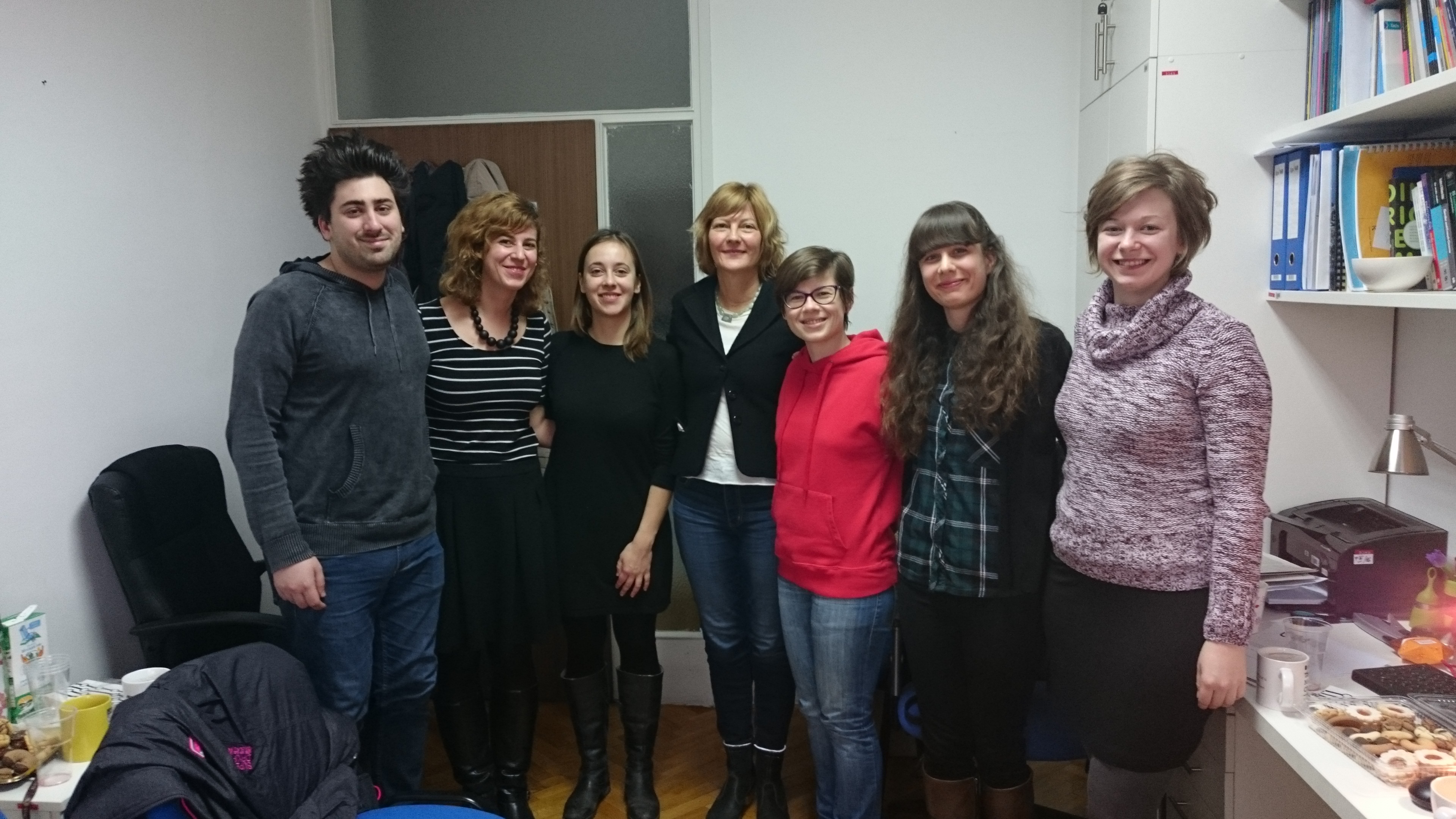
Na CIM-ovom projektu “Medijski sustavi u jugoistočnoj Europi: komparativna analiza post-socijalističkih medijskih sustava” (voditeljica prof.dr.sc. Zrinjka Peruško) uspješno su surađivali studentice i studenti novinarstva Fakulteta političkih znanosti Dubravka Grubišić, Petra Jakovina, Ana Maria Kezerić, Eduard Petranović, Sonja Smiljanić, Ružica Strelar te studentica makedonistike Filozofskog fakulteta Marija Luketina. Studenti su na projektu radili analizu sadržaja pod mentorstvom dr.sc. Antonije Čuvalo, dr.sc.Dine Vozab, i dr.sc. Dunja Majstorović.
Call for papers: submission deadline 29 January 2017
Scientific conference Agents of Power in The Transformation of Media Systems, 27 and 28 April, 2017, Inter University Center, IUC, Dubrovnik
Conference chairs: Slavko Splichal, University of Ljubljana, and Paolo Mancini, University of Perugia, Zrinjka Perusko, University of Zagreb
Organizers & venue: Post-graduate spring school on Comparative media systems, International University Centre, Dubrovnik, Croatia. www.iuc.hr
Speakers include Slavko Splichal, Paolo Mancini, Kaarle Nordestreng, Hannu Nieminen, Sally Broughton Micova, Tarik Jusić, Snježana Milivojević, Zrinjka Peruško, Andrei Richter.
The conference will be focused on significant changes in media landscapes in the period after the fall of communism due to globalization, media digitalization, financial crisis and the lack of alternatives (as once conceptualized in the idea of NWICO), experienced not only by the former communist countries but also all other countries. However, these processes usually remain completely ‘impersonal’ in scholarly literature and research: instead of actors, we only have processes. When J.K. Galbraith once wrote of the role of the ‘market forces’—the concept that replaced the ‘outdated’ concepts of ‘capitalism’ and ‘capitalists’— he suggested that, “It would be hard to think of a change in terminology more in the interest of those to whom money accords power. They have now a functional anonymity.”
Indeed, it is crucially important to focus on the dominant social actors in and behind the long-term processes, who otherwise may remain ‘functionally anonymous’. Instead of focusing on the role of the media within the economic, social, political and cultural systems of societies, we would like to examine the role of economic, social, political and cultural actors (such as media owners, corporate economic clients and advertisers, interest groups, content creators and journalists, audiences, citizens, civic movements, political parties, legislative bodies, constitutional court and judicial bodies, specific policy makers and regulatory bodies) in generating changes in media systems, particularly in the news media and journalism.
The aim of the conference Agents of power in the transformation of media systems is to focus on the key local, national and transnational actors who influenced the changes in media systems during the past 25 years. The newly established nation states that once were constitutive parts (republics) of former Yugoslavia may be used for a ‘thought experiment’ or exemplification to demonstrate how once a rather uniform media system (at least in terms of legal regulation) developed in different directions not only because of different ‘objective’ (e.g. economic) conditions but also or primarily because of different ‘subjective forces’ in action. Yet the same approach focused on the main power agents may also help explaining changes in media systems in the countries that did not experience the kind of (political) turmoil taking place in the former communist countries.
Please submit proposals of 250 words by January 29, 2017, to Zrinjka Perusko zrinjka.perusko@gmail.com. Decisions will be sent by mid-February.
For further information about academic matters please contact the organizing course directors: professor Slavko Splichal, European Institute for Communication, University of Ljubljana, slavko.splichal@guest.arnes.si or professor Zrinjka Peruško, Centre for Media and Communication Research, Faculty of Political Science, University of Zagreb, zrinjka.perusko@gmail.com.
The conference will be the final part of the post-graduate summer-school Comparative media systems: Media policy and regulation (IUC-CMS 2017), Inter University Center, Dubrovnik, 24-28 April 2017.
Since 2012 the post-graduate spring-school in Comparative Media Systems is held at IUC under the main supervision of Prof. Zrinjka Perusko. Scholars from different countries (including Carmen Ciller, Boguslawa Dobek-Ostrowska, Stig Hjarvard, Klaus Bruhn Jensen, Steffen Lepa, Snježana Milivojević, Paolo Mancini, Hillel Nosek, Kim Schroeder, Slavko Splichal) taught at the spring- school that this year is particularly devoted to “Media Policy and Regulation” and the Conference on “Agents of power in the transformation of media systems” is intended as a sort of major arrival point of the course.
IUC is seated in the beautiful city of Dubrovnik and since 1970s hosts courses and seminars convening together scholar from different parts of the world. More information about the venue is available at www.iuc.hr.
As it is IUC policy, participants are expected to cover the costs of their own travel and stay in Dubrovnik. Information and advice on travel and hotels will be circulated at a later date.
Postgraduate spring school on Comparative Media Systems: Media Policy and Regulation (IUC-CMS 2017), Inter University Center, Dubrovnik, 24-28 April 2017
Course directors:
Carmen Ciller, Universidad Carlos III de Madrid, Spain
Steffen Lepa, Technische Universität Berlin, Germany
Paolo Mancini, Università di Perugia, Italy
Snježana Milivojević, University of Belgrade, Serbia
Zrinjka Peruško, University of Zagreb, Croatia
Slavko Splichal, University of Ljubljana, Slovenia
Course Description:
A paradigm shift in media policy in the 1980s signified a move away from the post WWII public service media policy towards a new communications policy paradigm (van Cuilenburg & McQuail, 2003). Media policy research has also expanded into new territory (Just & Puppis, 2012). This year’s course will explore contemporary issues in media policy and governance focusing on freedom of communication, access, control/accountability and public service media in European media systems in a comparative perspective.
As part of this year’s course, the scientific conference Agents of power in the transformation of media systems will take place on Thursday and Friday (27 and 28 April, 2017), and will include attendance by the course participants. Speakers include Slavko Splichal, Paolo Mancini, Kaarle Nordestreng, Hannu Nieminen, Sally Broughton Micova, Tarik Jusić, Snježana Milivojević, Zrinjka Peruško, Andrei Richter.
The conference will be focused on significant changes in media landscapes in the period after the fall of communism due to globalization, media digitalization, financial crisis and the lack of alternatives (as once conceptualized in the idea of NWICO), experienced not only by the former communist countries but also all other countries. However, these processes usually remain completely ‘impersonal’ in scholarly literature and research: instead of actors, we only have processes. When J.K. Galbraith once wrote of the role of the ‘market forces’—the concept that replaced the ‘outdated’ concepts of ‘capitalism’ and ‘capitalists’— he suggested that, “It would be hard to think of a change in terminology more in the interest of those to whom money accords power. They have now a functional anonymity.”
Indeed, it is crucially important to focus on the dominant social actors in and behind the long-term processes, who otherwise may remain ‘functionally anonymous’. Instead of focusing on the role of the media within the economic, social, political and cultural systems of societies, we would like to examine the role of economic, social, political and cultural actors (such as media owners, corporate economic clients and advertisers, interest groups, content creators and journalists, audiences, citizens, civic movements, political parties, legislative bodies, constitutional court and judicial bodies, specific policy makers and regulatory bodies) in generating changes in media systems, particularly in the news media and journalism.
The aim of the conference Agents of power in the transformation of media systems is to focus on the key local, national and transnational actors who influenced the changes in media systems during the past 25 years. The newly established nation states that once were constitutive parts (republics) of former Yugoslavia may be used for a ‘thought experiment’ or exemplification to demonstrate how once a rather uniform media system (at least in terms of legal regulation) developed in different directions not only because of different ‘objective’ (e.g. economic) conditions but also or primarily because of different ‘subjective forces’ in action. Yet the same approach focused on the main power agents may also help explaining changes in media systems in the countries that did not experience the kind of (political) turmoil taking place in the former communist countries.
The aim of the postgraduate course is to gather doctoral students from media and communication or political/ juridical sciences occupied with media policy and regulation that want to discuss their current work with established and emerging scholars and get relevant feedback.
Course Organization:
This sixth “slow science” IUC-CMS is an interdisciplinary research conference & post-graduate course open to doctoral and post-doctoral students in media, communication and related fields. Each year the topic of the course will focus on one or a combination of areas that define media systems from a comparative perspective. A complementary methodological workshop will introduce selected qualitative and quantitative research methods.
Invited lecturers will deliver keynote lectures with ample discussion opportunities. Course attendees will have extended opportunity to present and discuss their current own works with the course directors and other participants in seminar form (English language) and in further informal meetings around the beautiful old-town of Dubrovnik (UNESCO World Heritage) over 5 full working days (Monday-Friday). The working language is English. All participants will receive a Certificate of Attendance.
Venue Information:
The Inter-University Centre was founded in Dubrovnik in 1972 as an independent, autonomous academic institution with the aim of promoting international co-operation between academic institutions throughout the world. Courses are held in all scientific disciplines around the year, with participation of member and affiliated universities.
Additional Information and Application:
For further information about academic matters please contact the organizing course directors: professor Slavko Splichal, European Institute for Communication, University of Ljubljana, slavko.splichal@guest.arnes.si or professor Zrinjka Peruško, Centre for Media and Communication Research, Faculty of Political Science, University of Zagreb, zrinjka.perusko@gmail.com.
To apply for the course and for information on accommodation and venue, please visit the IUC website: http://iuc.hr/course-details.php?id=997
Poligraf, 25.11.2016. «Sloboda medija i napadi na novinare»
Poslušajte emisiju Poligraf Hrvatskog radija od 25.11.2016. na temu Sloboda medija i napadi na novinare, uz sudjelovanje novinarke Sanje Despot, povjerenice za informiranje Ana Marija Muse, zastupnika u Hrvatskom Saboru Gorana Beusa Richemberga, i profesorice na Fakultetu političkih znanosti Zrinjke Peruško. Urednica i voditeljica emisije je Jasmina Popović.
Emisiju možete preslušati na linku: Poligraf: Sloboda medija i napadi na novinare_25.11.2016.
Prague, 9-12 November 2016
6th European Communication Conference
Mediated (Dis)Continuities: Contesting Pasts, Presents and Futures
CIM members are participating at the ECREA 2016 conference with several presentations, including the organization of the CEE Network Round Table. Information about the conference and program can be found at the conference website: http://www.ecrea2016prague.eu/
COMMUNICATION AND MEDIA STUDIES IN CEE: PAST, PRESENT AND FUTURE
CEE Network Round Table, ECREA 2016, Prague
Convenors: Zrinjka Peruško, Irena Reifova & Václav Štětka
Chair: Zrinjka Peruško, University of Zagreb
What is the state of the discipline of communication and media studies in CEE today? What are the topics, theories and research methods that predominate? More than a quarter century after democratic changes, communication and media studies in Central and Eastern Europe are a growing field, starting to be recognized across Europe. While the impact of CEE scholars is still small, and their work hardly visible in the European or international academic arena, the academic community of communication and media scholars is starting to focus on itself to study and understand its history and contemporary areas of research focus, supported to a great degree by the CEECOM conference and the ECREA CEE Network. While media institutions and journalistic practices developed in the CEE Europe in comparable historical times, albeit influenced by a different political and economic framework, the academic discipline did not develop under socialism in all the countries equally, as some communist regimes were more restrictive than others in allowing development of social sciences. Thus in some CEE countries, the discipline started to develop, or to communicate with the accumulated disciplinary knowledge, only after 1990. With this Round Table, we wish to focus our attention and discussion on disciplinary developments in CEE academia both in terms of its contemporary interests and research practices in terms of the institutional and cognitive histories of communication and media studies, including journalism studies, in socialist and post-socialist times.
Stepping out of the Shadow: Internationalizing Communication Research in CEE
Václav Štětka
Charles University, Prague, Czech Republic
vaclav.stetka@fsv.cuni.cz
While Central and Eastern Europe has been getting increasingly more visible on the map of international media and communication scholarship in the recent years, academic research originating in this region is still characterized by a notable structural gap when compared with the West, particularly when it comes to the ability of CEE scholars to break into the top-ranked academic journals in the field. My presentation will try to shed more light on this issue by elaborating on a pilot study of the publication output of CEE-based authors in communication journals indexed in the Web of Science over the last decade, with particular respect to genres and topics of articles, types of methodologies and forms of authorship. Based on this preliminary analysis, I will further discuss the existing publication challenges faced by the CEE authors as well as some more promising trends and strategies with the potential to bridge the gap and increase the international impact of CEE communication research in the future.
Communication and Media Research in Poland
Malgorzata Winiarska-Brodowska
Jagiellonian University, Krakow, Poland
winiarska.m@wp.pl
The purpose of this paper is to present the development of media and communication studies in most important academic centres in Poland. Taking into account the specific political and economic circumstances it describes the process of establishing the foundations of the Polish media and communication research and its traditions. The presentation aims at analyzing the role of Polish institutions such as the Press Research Centre in Krakow in the exchange of ideas among researchers from Central and Eastern Europe as well as their contribution to the flow of theoretical and methodological concepts between the countries of the East and the West. It examines institutional changes in the field throughout last decades, especially concentrating on the period after 1989. The paper introduces different trends and research orientations in Polish academia. It also discusses contemporary challenges that need to be faced by researches who explore press, radio, television and internet in Poland.
Russian Journalism and Media Studies: Moving to Global Academia
Elena Vartanova
Lomonosov Moscow State University, Russia
eva@smi.msu.ru
The paper is aimed to summarize the changes in academic approaches to the journalism and media in Russia in 1990s-2010s, to discuss trends in transition of media studies within the Russian academia and to analyze specific features of the national media research school. The transformation of post-Soviet journalism and media studies had been a very complex and uneasy process. The core problem was a clash of ideological and instrumental nature of the Soviet propaganda, professional standards adopted from the Western journalism by new generations of media professionals and development of media as a part of Russian hybrid market-state economy. Theories imported from the Western discourses became the most influential factor in changing media landscape at the first stage of transformation in early 1990s. The second stage, in the late 1990s, has been characterized by national contextualization of imported concepts and methodologies. It was also characterized by the growing importance of applied research inspired by the growth of media industry and advertising market. From the early 2000s, the national school of media studies began to converge ‘Western’ influences, local reflections and national sociocultural traditions. Currently, in 2010s, Russian media research enters a new phase of shaping modern vectors of national media studies by integrating the global and the national, the new and the old and by trying to establish new paradigms of analysis for a hybrid media system and convergent journalism.
Researching Journalism in Socialist and Post-Socialist Croatia
Zrinjka Peruško
University of Zagreb, Croatia
zrinjka.perusko@gmail.com
Dina Vozab
University of Zagreb, Croatia
dinavozab@gmail.com
Dunja Majstorović (presenter)
University of Zagreb, Croatia
dunja.majstorovic@gmail.com
How has academic research of journalism changed with the demise of socialism? How has the role of journalism, viewed through the academic optic, changed through time and different political systems? We wish to approach the answer to this question by the analysis of academic articles on communication and media studies in Croatia in the past +50 years. The present paper builds on the traces of intellectual history and present of the communication and media studies and its thematic and paradigmatic foci on the basis of content analysis of articles dealing with communication topics in social scientific and communication/media journals published in Croatia between 1969 and 2011 (Peruško & Vozab, 2013, 2014). The sample includes 481 articles, constructed from all full original articles published in odd years starting in 1969, dealing with communication and media topics in the most important Croatian social scientific journals all full original articles in the academic journals devoted exclusively to media and communication studies (all of them established after 1990). While the articles relating to journalism increased significantly after 2000 (to become the most frequent topic), articles on media content and production appeared also in the socialist period. Employing thematic analysis we aim to supplement our earlier findings, and contribute to better understanding of the changes in the perceived role of journalism and its scholarly understanding in Croatia.
Zagreb, 12-14 June 2015
8th CEECOM 2015 Conference The Digital Media Challenge


Centre for Media and Communication Research, University of Zagreb, ECREA and ICA organized CEECOM 2015, 8th Central and Eastern European Media and Communication Conference, „Digital media challenge“, which was held on Faculty of Humanities and Social Sciences in Zagreb from 12 to 14 June. The conference aimed to refocus on the challenges to media industries, media audiences, and media regulators posed by the digital transition in the Central and Eastern European region and beyond. Since today’s media have an increasingly global dimension that is manifesting together with the digital technology, it was a setting for a discussion about the manifestations of these global developments and their challenges in a regional setting. Conference proceedings are available here.
 Centre for Media and Communication Research